
Book 11: HOW TO GROW LILIES ON THE MOON
If you know a little bit about me, you might know that there are two topics I am personally quite fond of: solitude and sci-fi.
In more concrete terms, I absolutely adore being alone and watching the Roci perform high G maneuvers for the n-teenth time (this was an Expanse reference - if you got it, should we get married???). I had covered both of these topics in previously released songs (read: House Party and August). But despite these being two Venn diagrams at the very core of who I am, it had never crossed my mind to intersect and overlap them. That is, until I found a peculiarly titled book cover: How To Grow Lilies On The Moon. To this day, I do not know what the book was actually about, but boy oh boy did it ignite a spark of imagination.
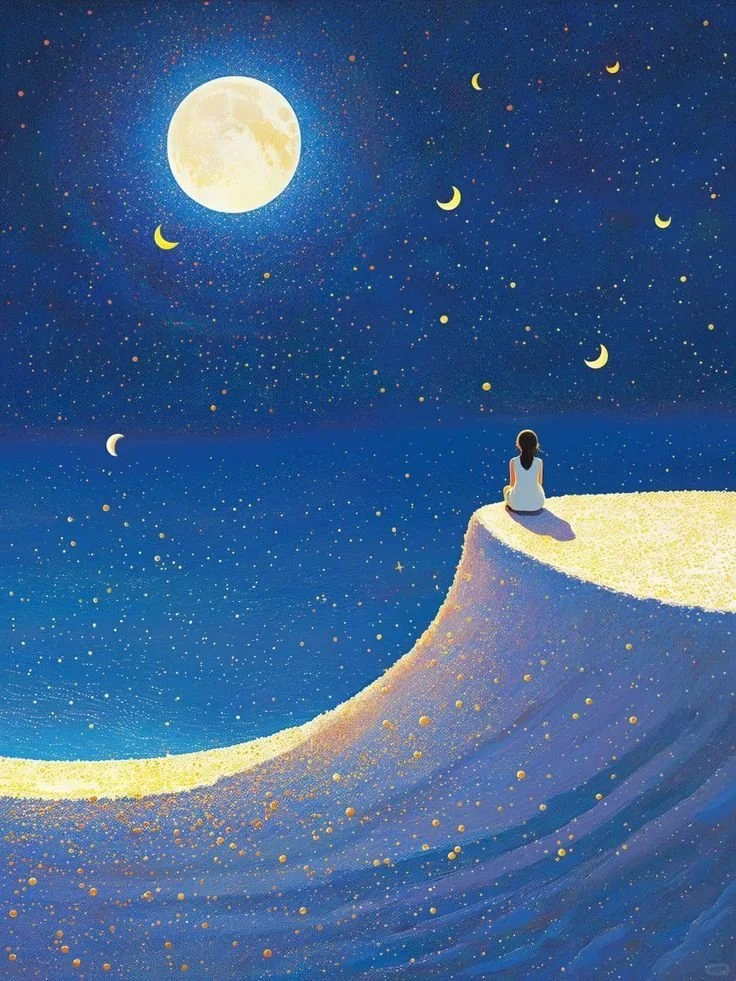
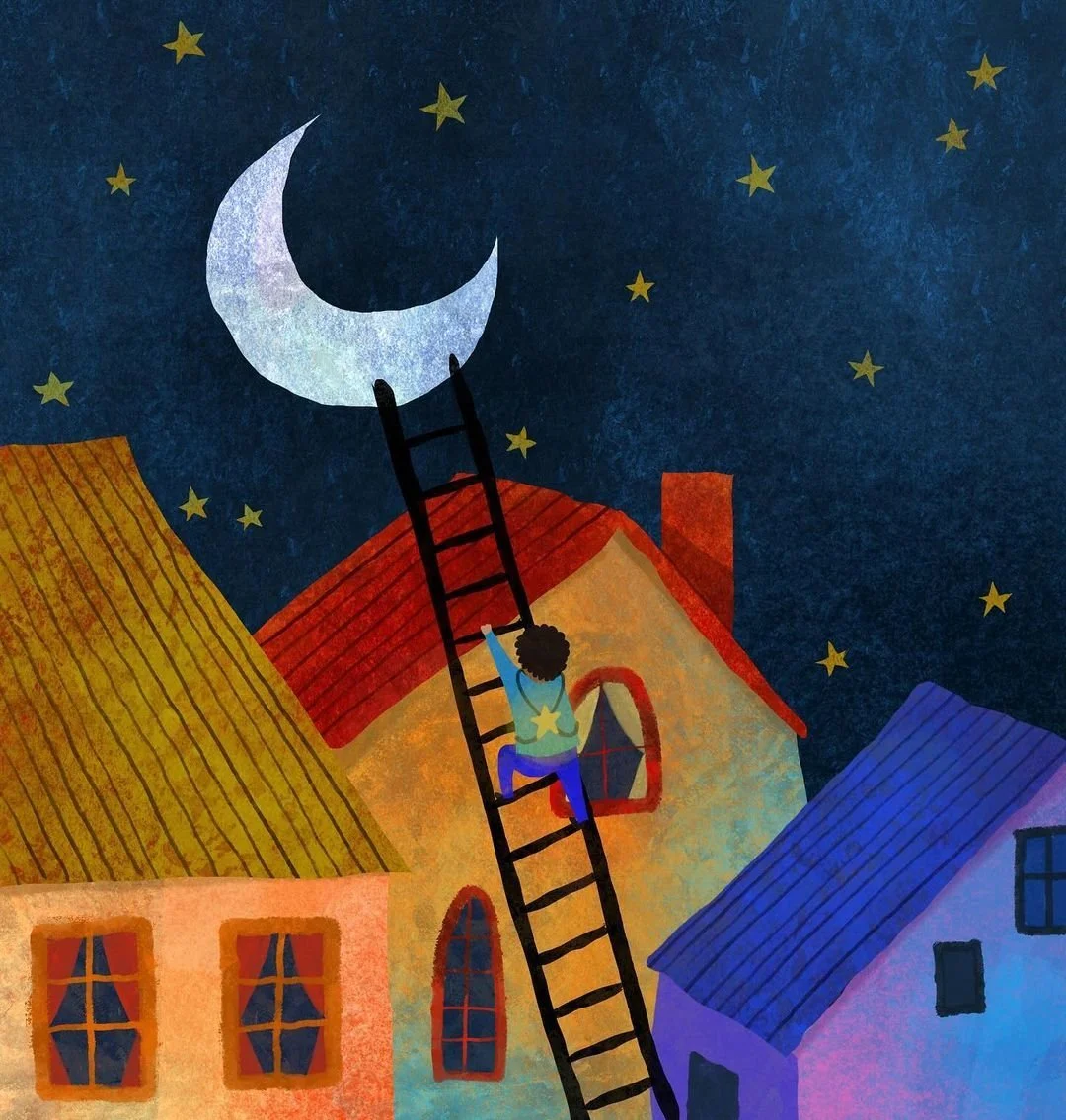
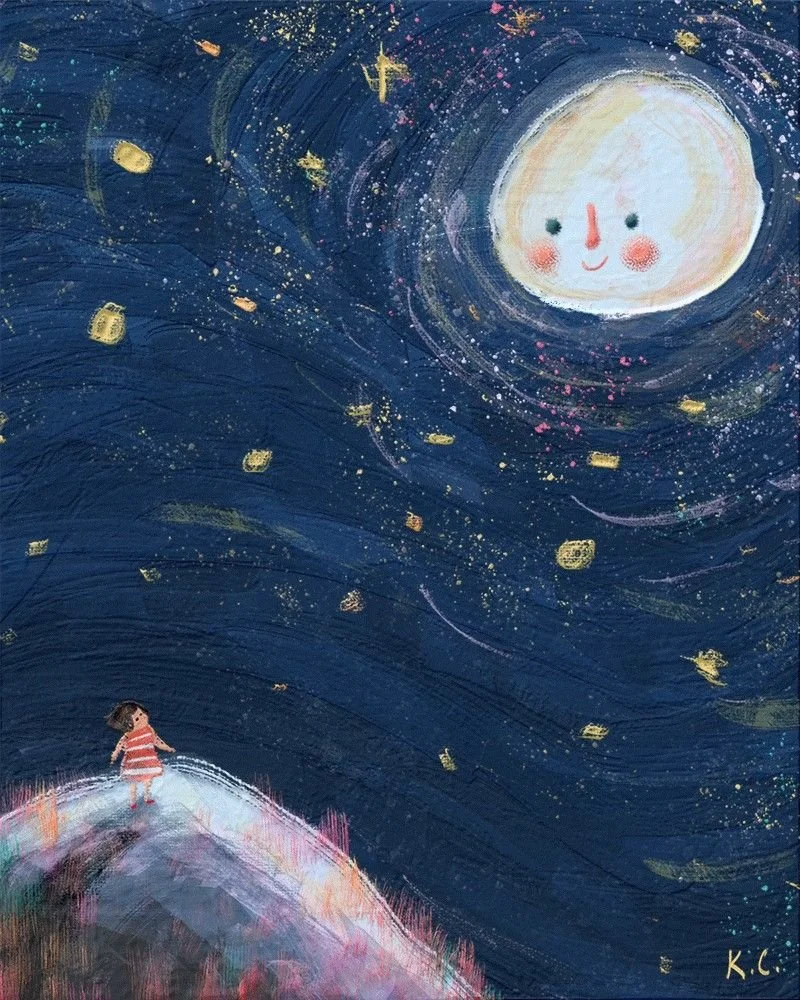
I think what made the title so effective was its unusual combination of usual words. We talk about lilies and the Moon in casual conversations of everyday life, but paired together, they feel curiously, excitingly whimsical and odd. I immediately knew what the song with such an endearing title should be about: embracing solitude.
Writing these blogs often feels like following a treasure map - picking up little clues in the memory storage of my phone to try and retrace my own steps. In the moment when I’m writing a song, I frequently lose track of time or specific solutions I find to get to a final decision, or lyric, or melody. It’s all part of a continuous thought, not unlike a tree: starting at the root and branching off in all directions as the original idea grows, evolves and matures. When I sit down to write this blog, it’s usually months after the song is already written, fully produced, and its visualizer filmed. In the kaleidoscope of events and tiny fragmented choices that I make along the way, I tend to forget how exactly it all came together. For example, it wasn’t until I started digging into my phone’s voice memos, that I rediscovered the song originally had a completely different chorus melody:
*side note: I love listening back to these voice memos because you can hear the excitement in my voice - the little screech in the beginning is one I often let out if I feel I’m on to a fruitful idea :)
From what I can reconstruct in my mind about the timeline of this song, I do remember that the first line I came up with was the opening:
they say there’s a girl
who lives on the Moon
If I can, I like to start my songs with an attention-grabbing lyric, something that is either odd and unusual or very contemplative; serving almost as a mini musical elevator pitch to spike your curiosity and invite you to keep listening to find out just what the heck those lyrics meant. :)
Beginning a tune with talking about a girl who lives on the Moon felt appropriately strange and whimsical and was even more effective once I changed out the line that follows it:
takes lunar walks
in the afternoons
This now sounded like the beginning of a fairytale and provided the foundation on which I could build more complex characterization.
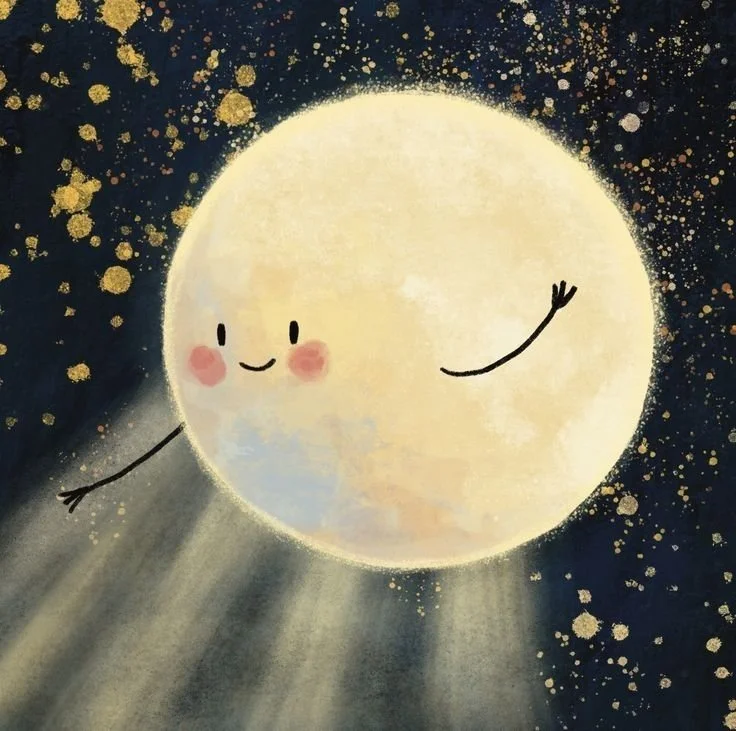
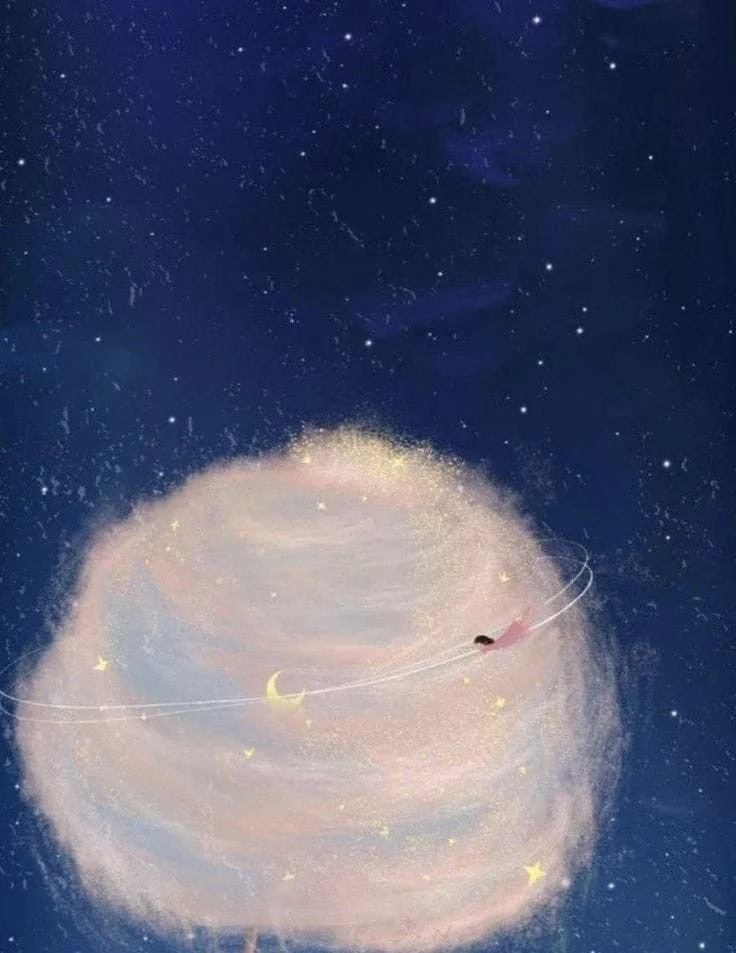
Around this time, I had just finished rewatching Prometheus and First Man - the concept of this song made me so excited that I spent that same day’s afternoon sitting at the piano, trying to channel spacey sounding melodies. I came up with this (I think it’s one of my favorite melodies I’ve ever written):
I like how open and floating the melody sounds and I was particularly psyched about ending the motif on those last three notes - they remind me SO much of the Prometheus soundtrack. It’s just a major third, but played at that rhythm, it feels like a curious glimmer of a star; like the universe winking at you and telling you there are unimaginably magical secrets out there, just waiting to be discovered. As the chord progression and general sonic palette of the song were gradually being laid out, I went back and came up with a more fitting chorus melody:
As someone who has consumed an unusually large amount of sci-fi content, I could see so clearly what this song had to be, what it needed to feel like. The sonic direction was so clear, but too bad I had no idea what to do with the lyrics haha. I was faced with a similar problem that I had back when I was working on Timekeeper’s Secret. How do I capture a complex concept in a way that does the topic justice, while still stays relatable? How can I use actual astrophysics information to ultimately tell the story of embracing aloneness, of the beauty in solitude?
As has now become the norm with me, I was taking a very hot, vey long shower that night and could not stop thinking about this dang Moon song. It carried so much potential to be truly special, if only I could find a way to hit the right balance between science and substance. Blame it on the steam, blame it on my body wash, or blame it on me being a night owl but suddenly, it crossed my mind:
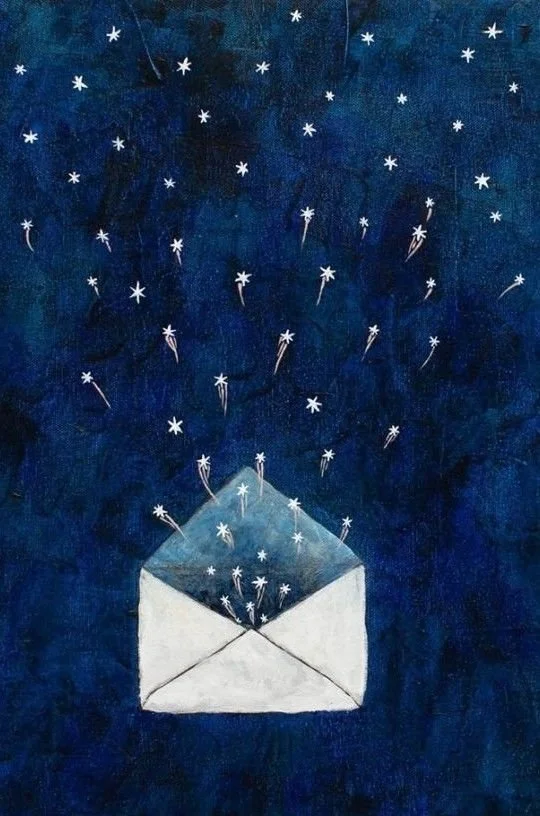
orbiting the Earth
she is close but always far away
gardens in the grey
learned to bloom now
she’s growing lilies on the Moon
The lines were strikingly simple, but in context of the song, this chorus felt deep and emotionally impactful. I had also, at that moment, realized something quite surprising: I was writing about myself. As much as it felt like I was telling a story when I first had the idea for the song earlier in the day, it turns out the girl living on the Moon was me. Somehow, subconsciously, I got started on a song about something so personal, so vulnerable about myself without even being aware of it. Writing in the third person made it feel safe, ambiguous enough to be able to share. If you didn’t know, I adore being alone. I have very few, very select friends whom I almost never see in person. Writing this, I actually don’t know why that’s the case - my best guess is that I love routine and being in control of my surroundings, curating every tiniest little detail, and bringing in unknown variables runs the risk of me losing control (that’s probably also why I enjoy playing Sims where all I do is build aesthetically pleasing houses and have families with wonderfully boring and repetitive lives). I think that’s also partially due to the fact that I am extremely close with my family; my parents and my brother Klemen are my bestest friends and we tell each other absolutely everything. If I get so much unimaginably wholesome and pure love from those nearest to me, why seek it elsewhere?
I spent my teenage years and early 20s doing everything to go against this internal instinct I had. I found myself in friend groups, hanging out on the weekends, going to the beach or the movies, crafting and making pancakes together. The people who were in my life at that time were undeniably wonderful and kind, and the moments we spent alongside each other will forever be a part of my youth, my story. But still, I consistently found myself feeling empty when coming home from these hangouts; misunderstood and sad and relieved that I was finally home, with my family. I suppressed these feelings until early 2020 when the Covid lockdowns hit and forced me to live in my own little bubble, with my own little family. As awful and horrible as that time was for the whole world, psychologically, I was happier and calmer than I ever was before. I took long walks and observed nature as it changed through the seasons, and started to discover so much purpose and meaning outside of just my work. Turns out, there’s so much beauty in simply existing alongside the wondrous nature of our world and reality, and realizing the magic of your very own existence within it. It was the kind of peace that I was unfamiliar with before and for the first time in my life, I felt that I was truly, fully embracing who I am.

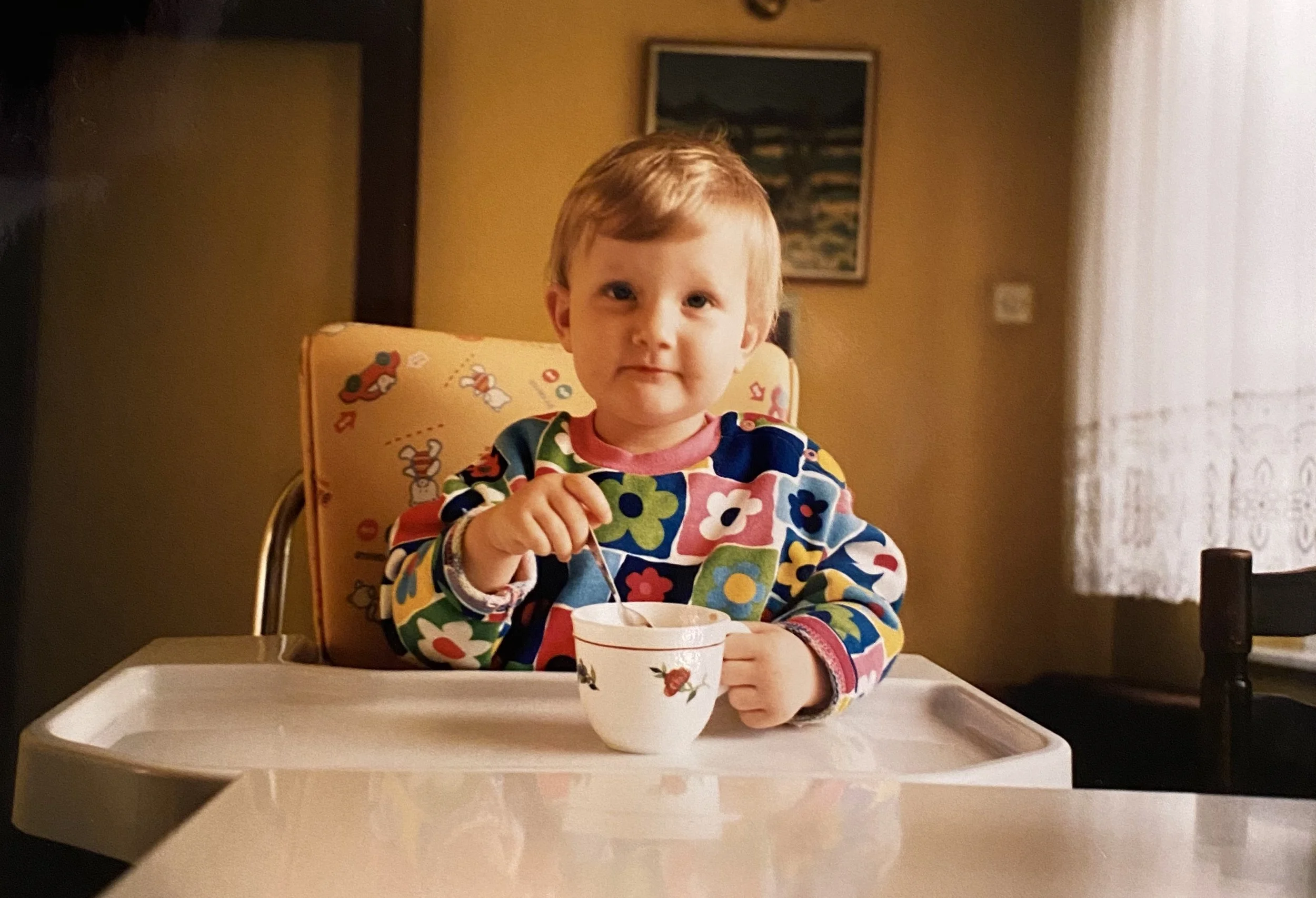
Excuse me for this little rant, but I think its’s the key to understanding this song; where it came from and why it means so much to me. Once I realized I was writing about myself and for myself, it was much easier to crack the code of the rest of the lyrics. I sunk my teeth into some lunar research and wanted to describe actual cosmological phenomena as metaphors for embracing solitude:
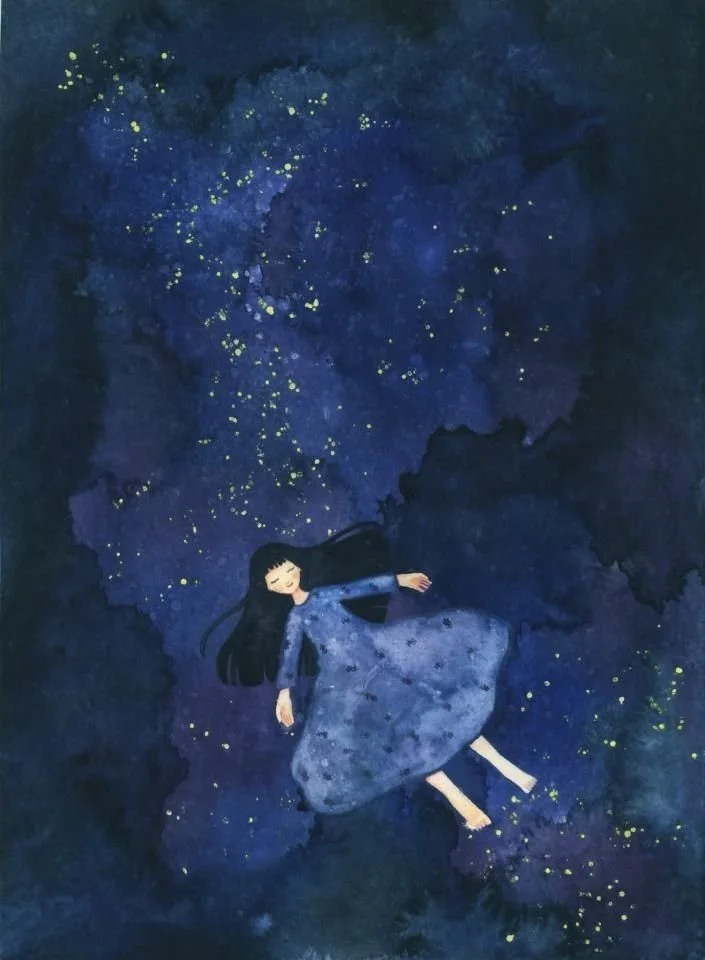
“she watches the Earth from a tidal-locked ledge”
The Moon is tidally-locked to the Earth, meaning we only ever see one side of it from down here (hence the 'dark side’ of the Moon aka the side that is always facing away from the Sun). This also represents keeping a part of yourself, for yourself - not letting the world know all of you.
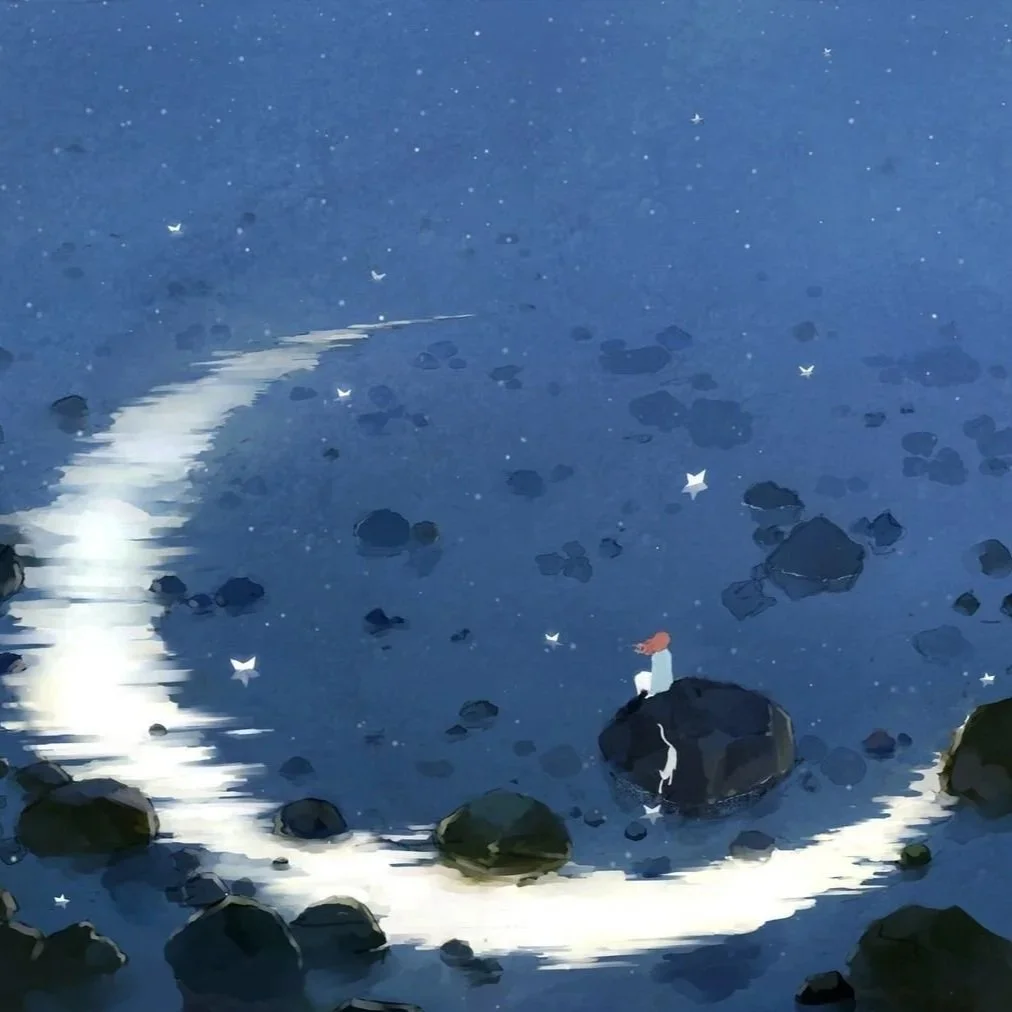
“her feet barely touching the dust she calls home”
The Moon has about 1/6 of Earth’s surface gravity so you almost float across it. This also represents the notion of being a daydreamer, someone with their head in the clouds - observing, absorbing and thinking about the world around them.
Here’s the first verse and chorus that I recorded the day after I first had the idea for the song, with (almost) all of the final lyrics that you know today:
I played through this song over and over, on the piano and then on my phone. I knew it needed a big, climactic bridge that would add another layer to the idea of protecting your peace. I spent the next few days thinking a lot about the philosophical implications of this ‘loner’ approach to life. While lilies can be grown and beauty can be found in the solitude of the Moon, I didn’t want the song to feel too isolationist. Instead of being reclusive, the message is more about getting to know oneself: being so sure of who you are that you can be comfortable and at peace with yourself in silence and aloneness. But that doesn’t mean you shut yourself off from the world, it simply means that you don’t compromise on who gets to sit in that silence with you. That’s where the bridge comes in: if someone is truly, deeply in love with you, they will invest effort in coming to your Moon.
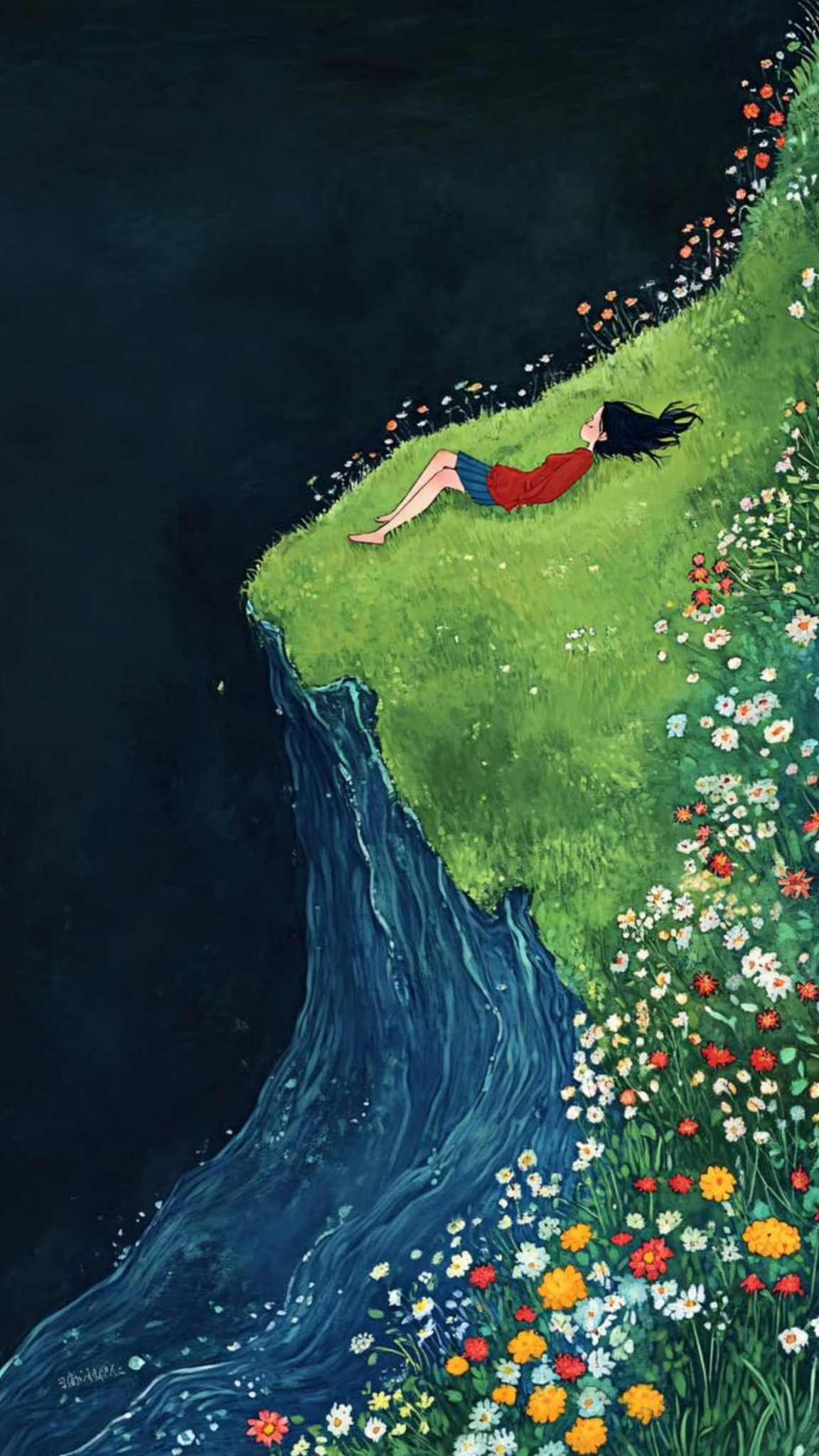
build a rocket to go and see her
that’s what falling in love is for
With the song now fully written, I was eager to start working on its production. I went back and listened to the soundtracks of some of my favorite sci-fi films, especially Hans Zimmer’s Interstellar and Justin Hurwitz’s First Man. I was trying to dissect the production and underlying composition to identify certain sounds or intervals or chords that feel otherworldly and space-y. I also dug through my sheet music and found my beloved Clair de Lune - I played through it obsessively, analyzing the song’s magical (yet surprisingly simple!!) chord progressions.
During my research, I found out that a lot of NASA Mission Control audio has been archived and is now available for public use - how crazy is that!? I listened through a bunch of these recordings and found the single most perfect fit, from none other than the Apollo 11 mission:
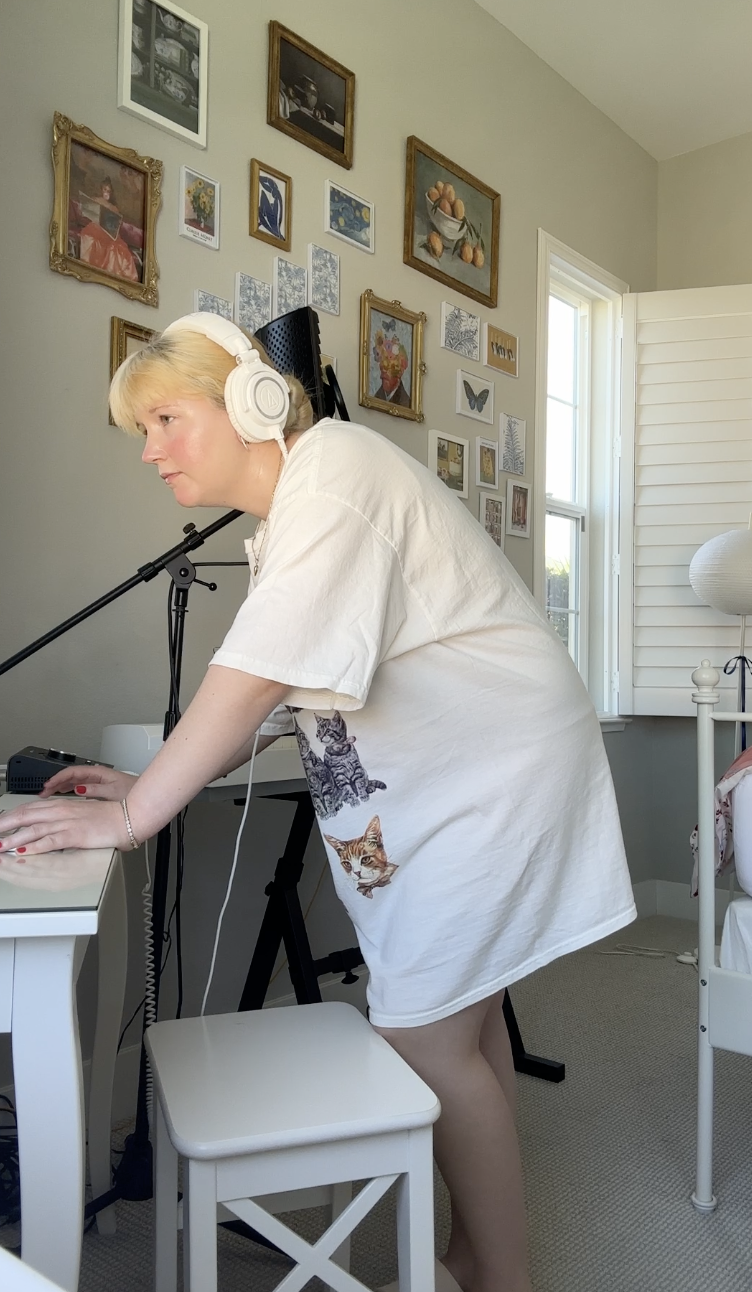
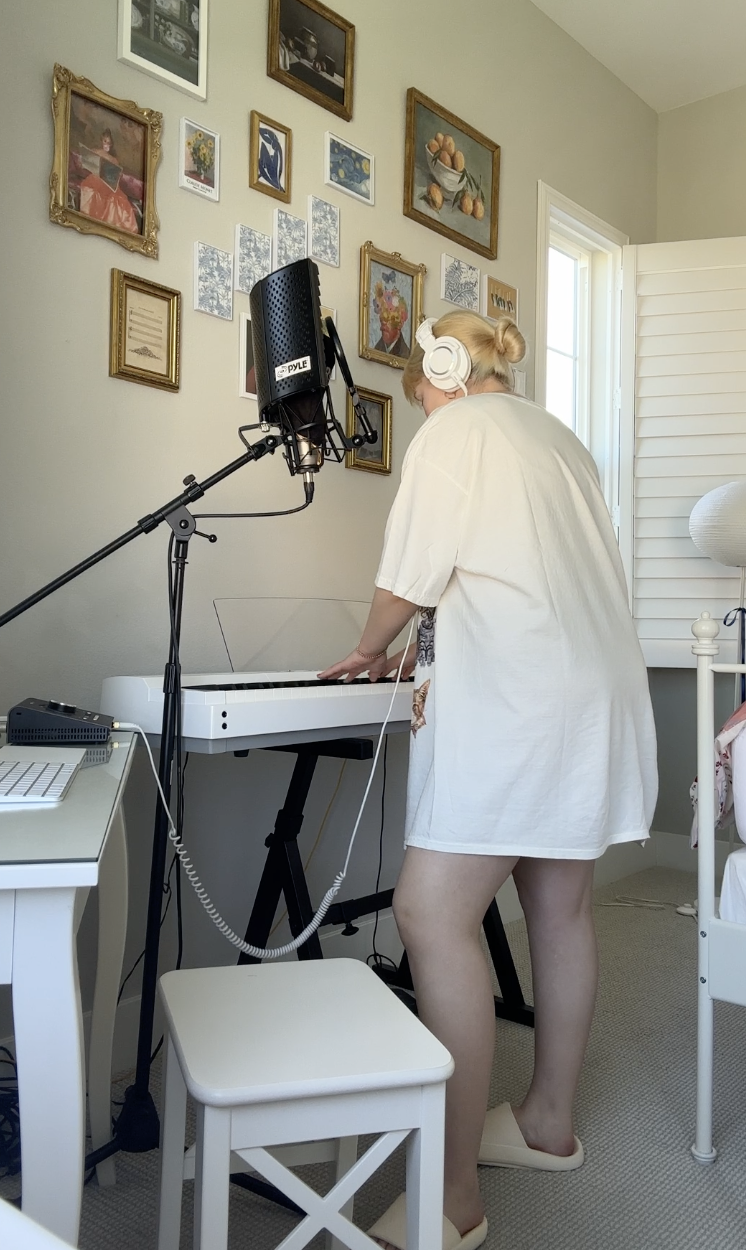
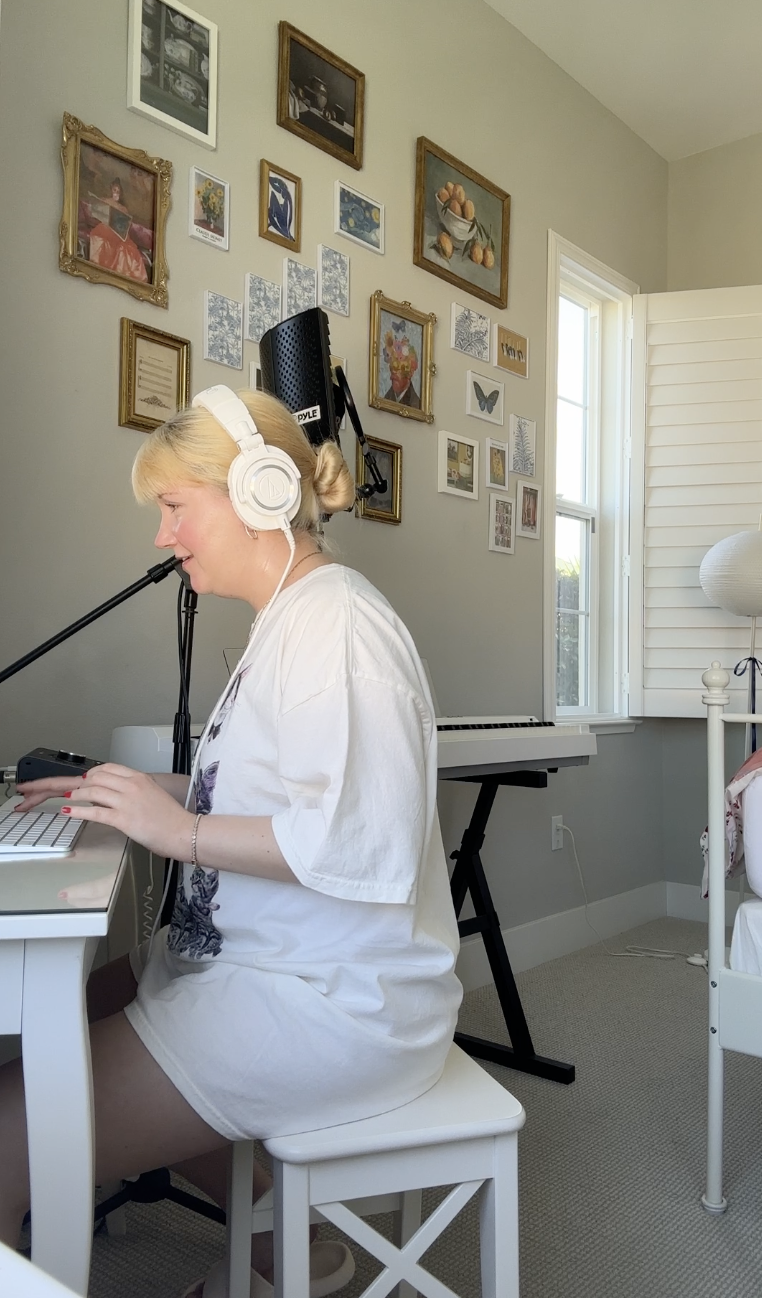
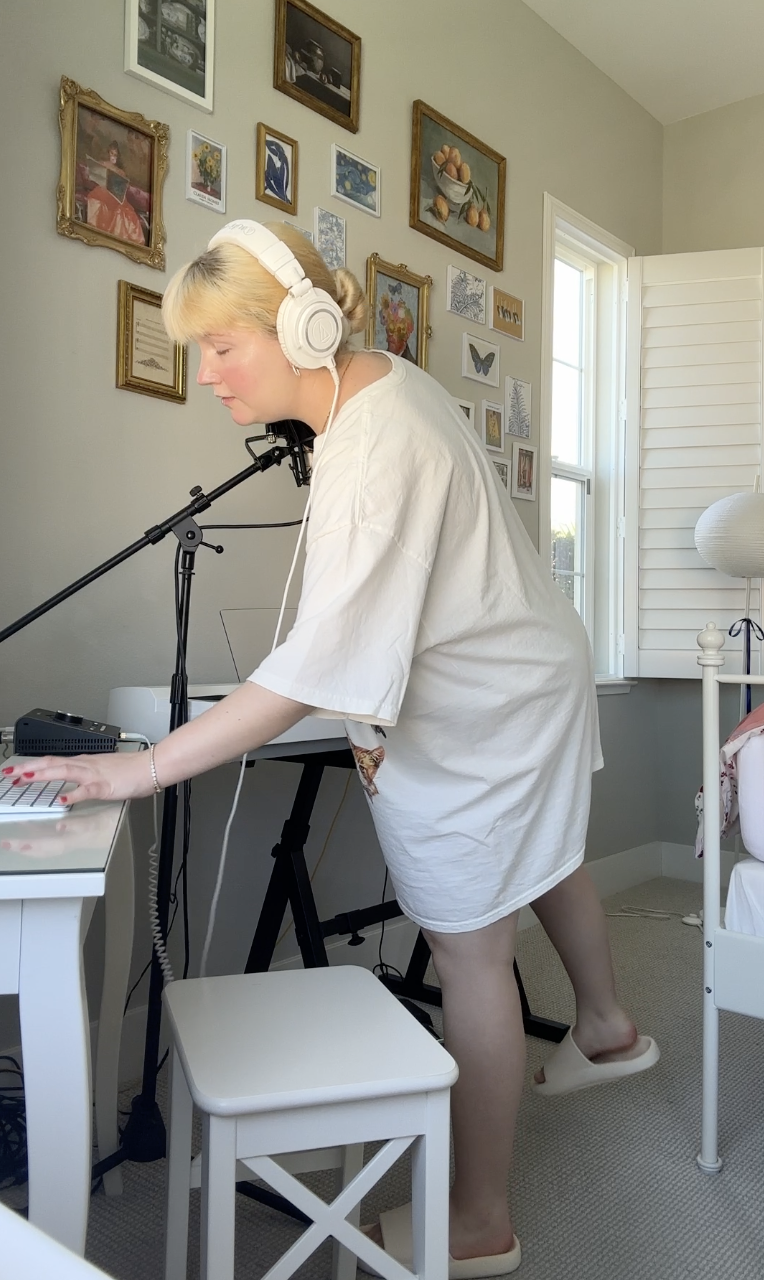
Once I decided to use this NASA audio as the song’s intro and outro, I also knew I needed to bring back my good buddy Claude Achilles Debussy - even though I previously used his fantastic lunar tune in the August song, one simply cannot compose of the Moon without Clair the Lune. But to spice things up, I used a different part of the composition, the twinkling arpeggios that bridge the introductory melody with the more settled middle section:
As I was tinkering around with the song in Logic, I realized that there were two key elements that I needed to incorporate in my production in order for everything to feel like you’re dancing and floating through space:
pedal tones: using instruments that would play just one note (in my case the tonic of D Major aka D) throughout the song so that no chord ever feels truly settled (or should I say tethered?)
repetitive arpeggios: melodies that feel circular, so as to mimic the orbiting motion of the Moon around Earth (I also used a lot of binaural audio mixing, as well as rotor cabinet and tremolo effects that make sound travel from one side to the other)
Once I had these directives in mind, the song came together in a very satisfying, puzzle-like way. I pulled ideas from film and classical music and learned SO much about different mixing and editing techniques and tricks that help sound feel immersive, like it’s circling around you. I kept obsessively listening to sci-fi movie soundtracks, heard an idea and incorporated it into my song.
After a few weeks, here is the final production demo I ended up with (notice the glaring absence of drums - I was absolutely convinced this would be a no-drum song):
I had sent off the strings tracks to Yoed Nir who replaced them with cosmically majestic live recordings:
I exported and prepared everything for Noah Taylor so he could get started on the song’s mixing and mastering. I thought it was all done and ready to go but as Noah was working on the track, he quickly added in some drums to see if I liked it and wowie zowie did it absolutely save the song!!! Overflowing with excitement, I reached out to Chris Hill (who records the live drums for all my songs) and begged him to do a crazy fast turnaround recording of the drums for How To Grow Lilies On The Moon, which was now very much not a no-drum song hehe.
He came back to us a few days later with the most cathartic, grand drums:
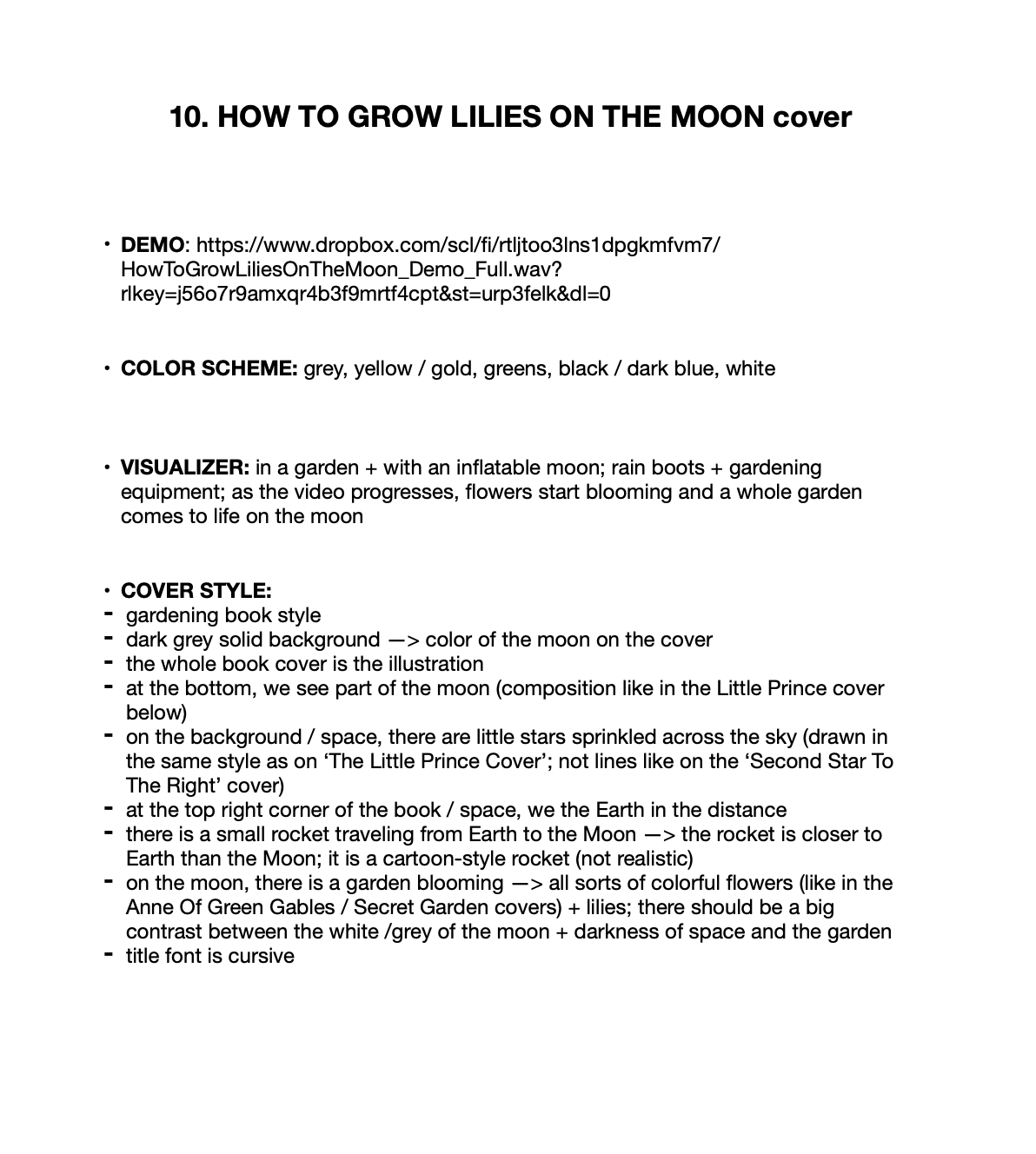
It was now high time for me to start thinking about the visuals for this song. Since the whole composition and production for this one had a very singular, specific environment, all I really had to do was continue pulling at that thread. I put together a little brief to send to Vida Igličar (the incredible Slovenian illustrator, author and graphic designer who has been drawing up my covers since the calendar songs project).
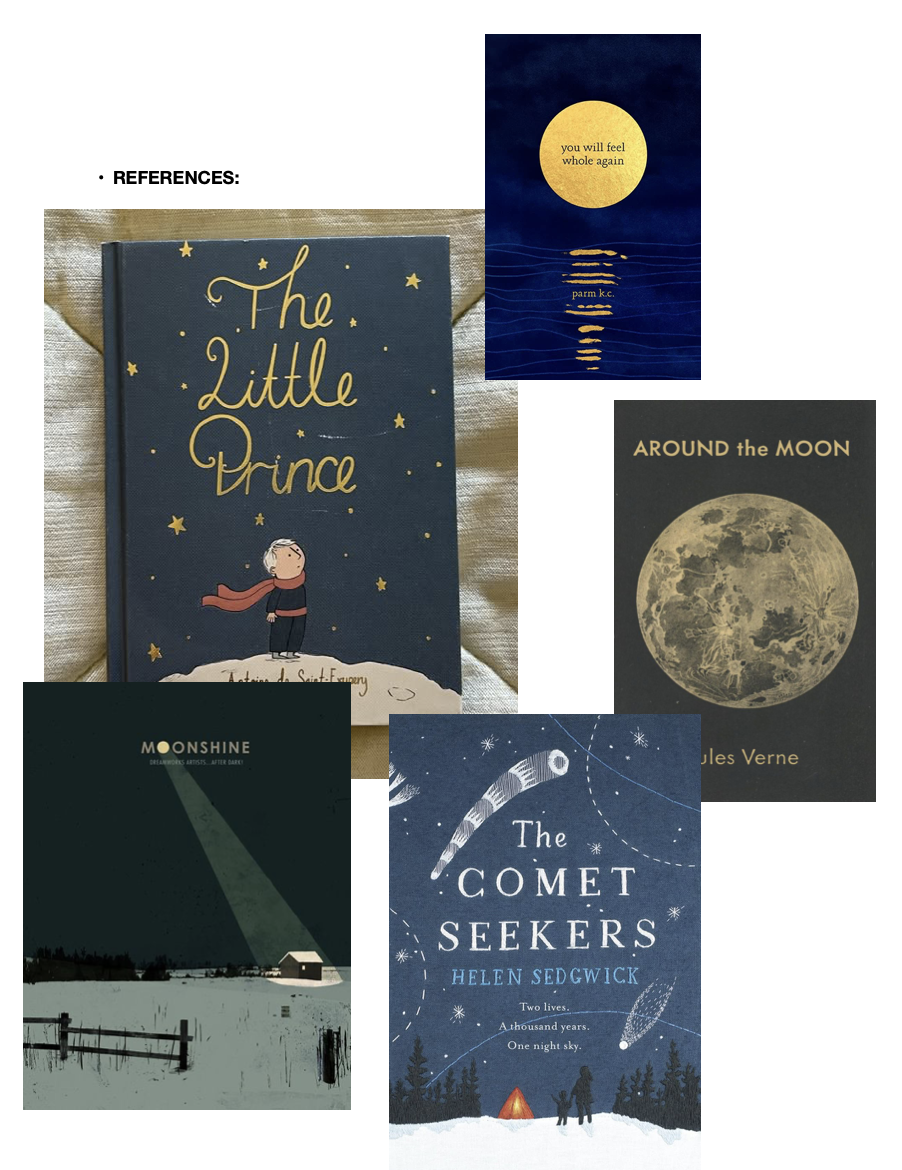
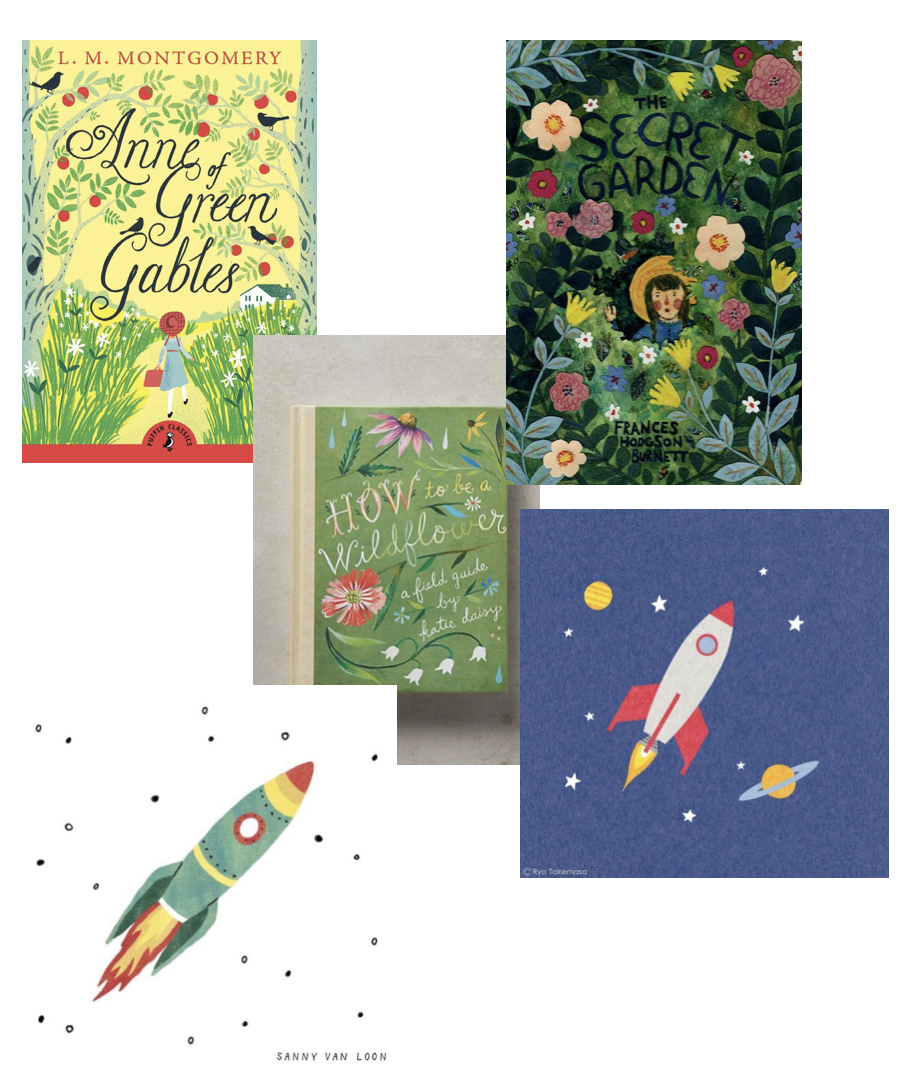
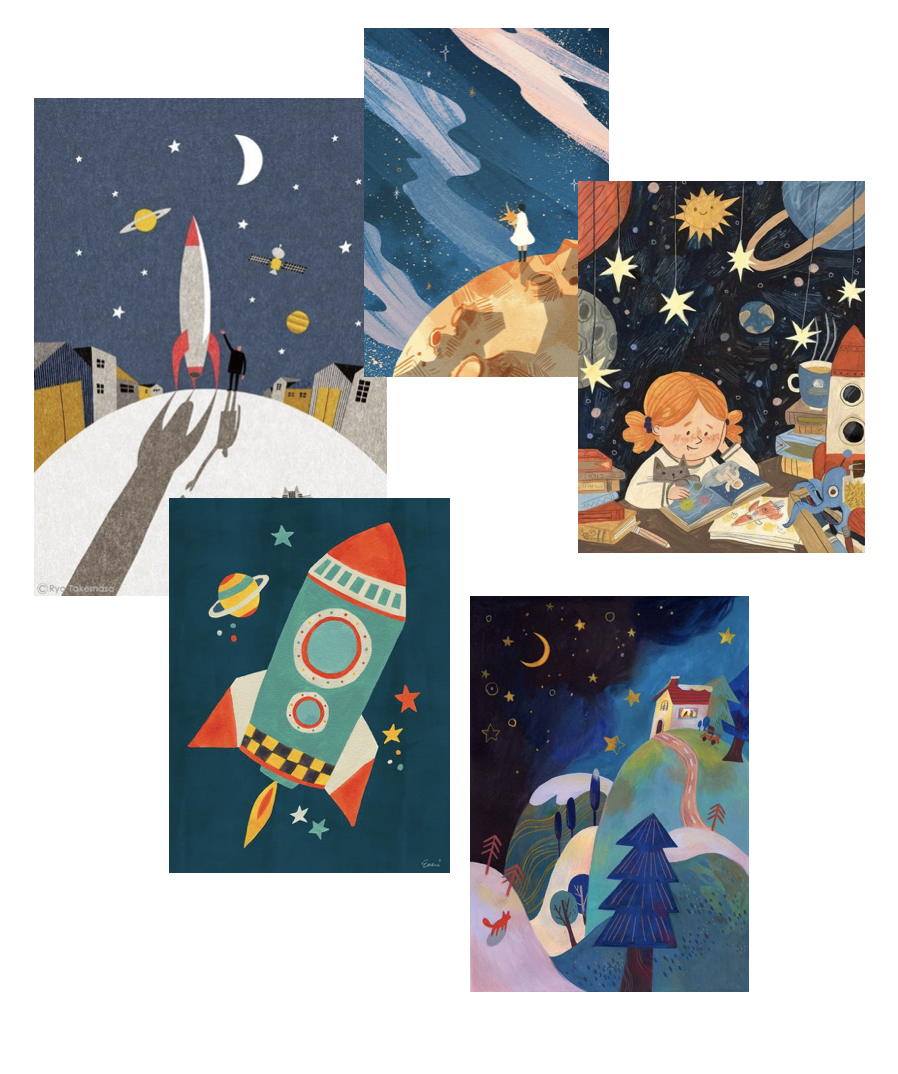
I also added some color / style references to the document:
From left to right, you can see the progression of the covers we worked through - she sent her work over, then I responded with some ideas and tweak suggestions. We went back and forth a few times until we arrived at the final cover:
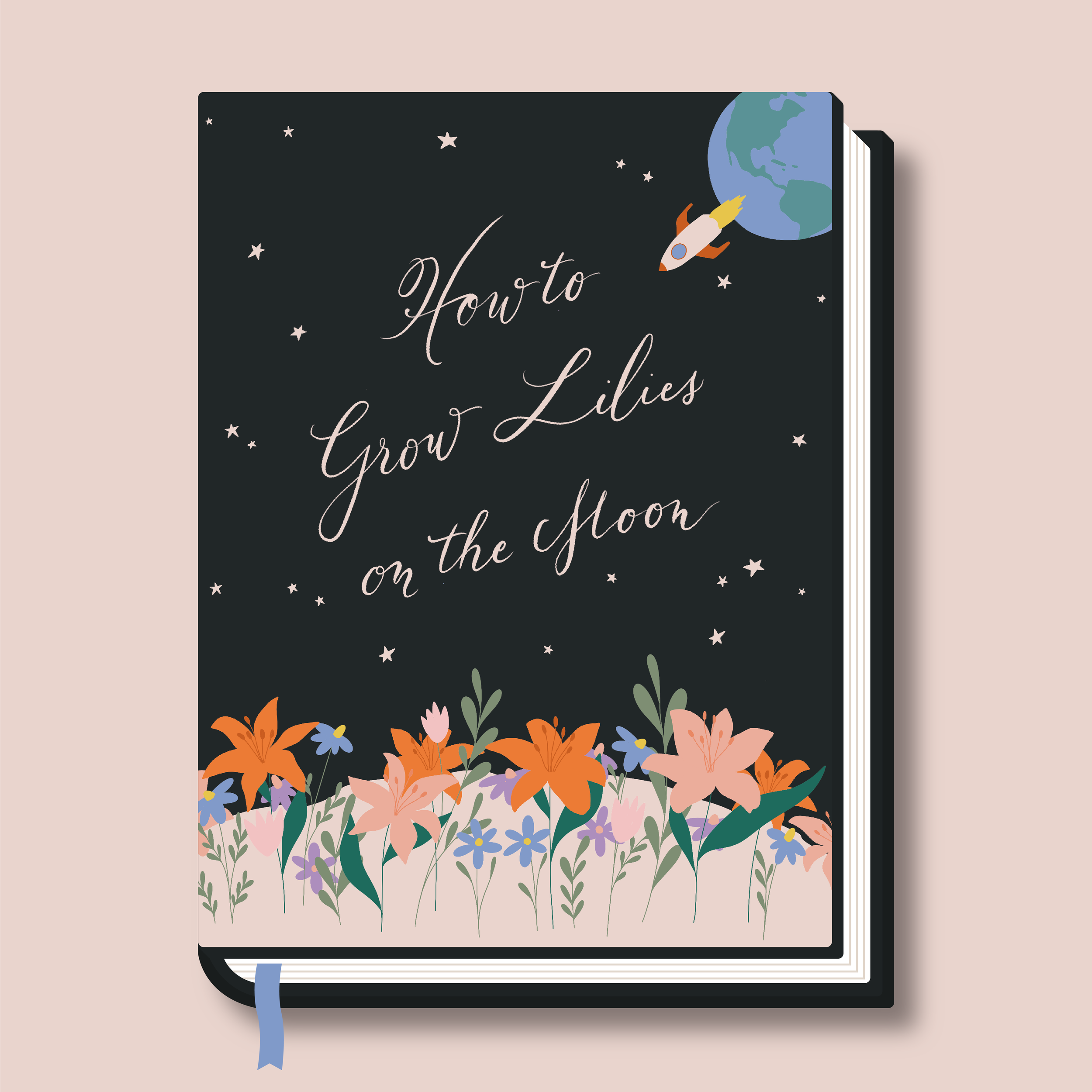
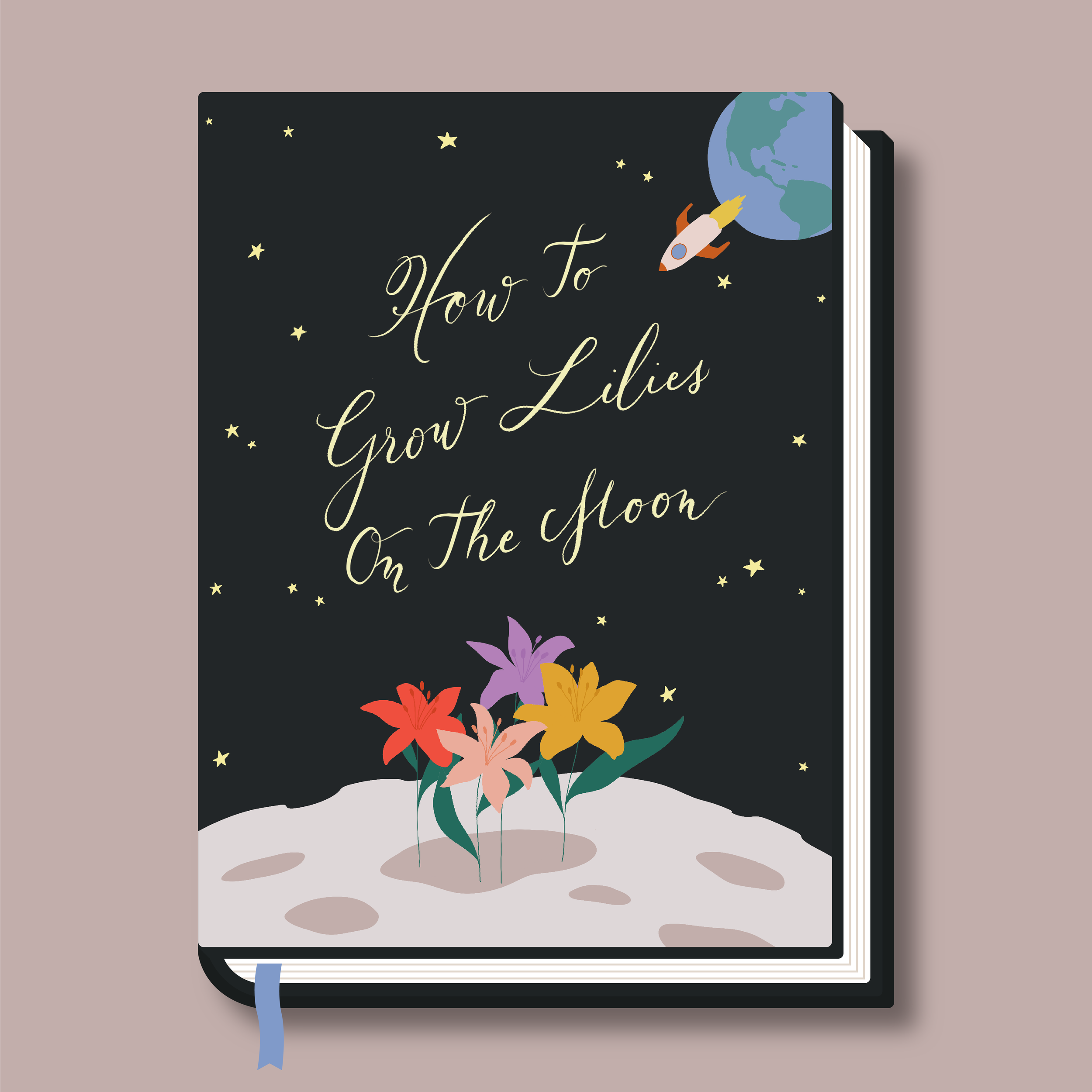
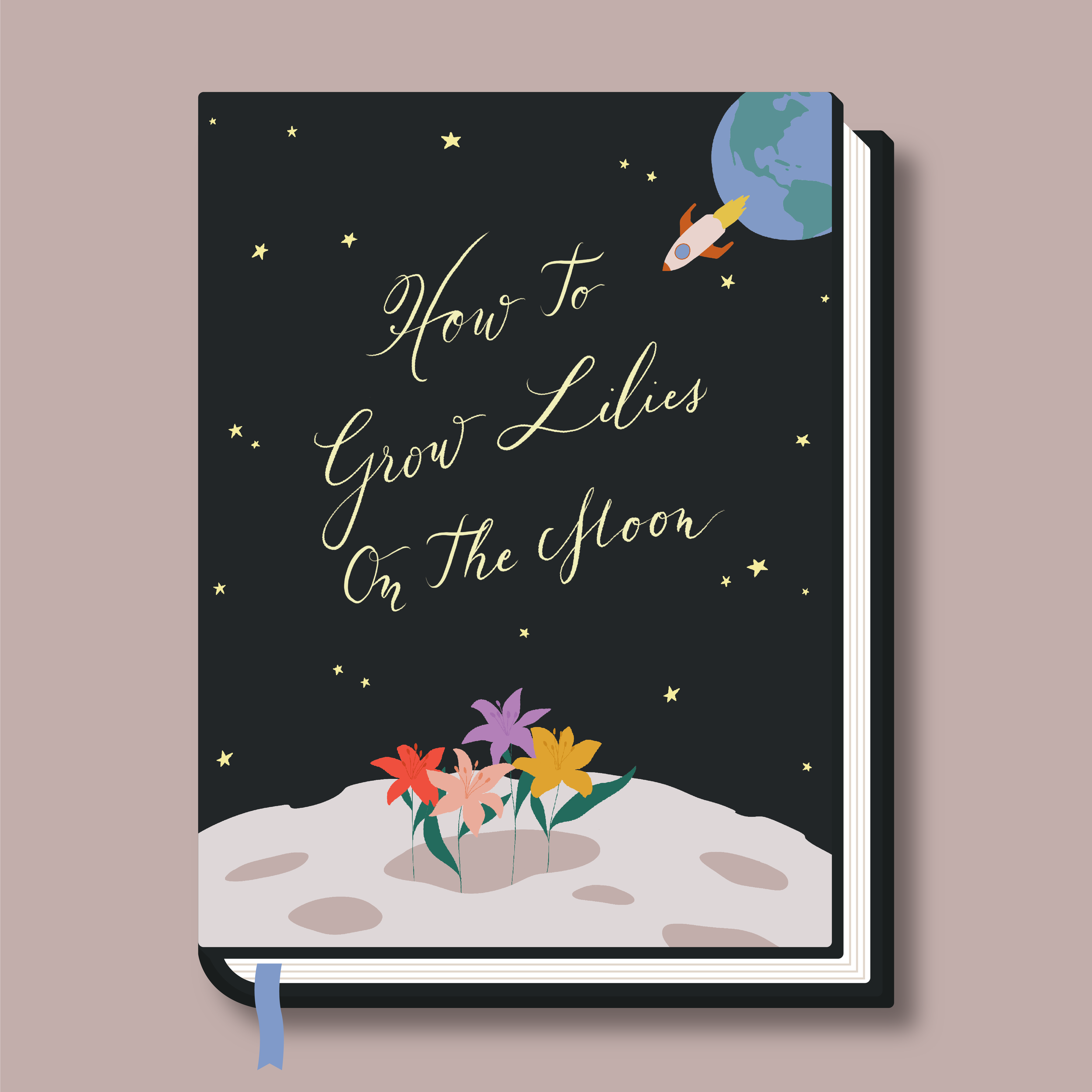
As Vida was working on the cover, I also started planning out the music video for the song. Once again, I knew I needed to continue with the visual and sonic narrative that I created for it so far. The idea of gardening in isolation kept bringing me back to TheMartian where Mark Watney grows potatoes on NASA’s Martian base. I couldn’t get that movie out of my head, it seemed like such a great reference for what I was trying to do with the music video for this song. I wanted to depict a girl living on the Moon (groundbreaking!!) who reads a manual on How To Grow Lilies On The Moon (please gasp in surprise) then builds herself a garden in the solitude of the celestial body’s desolate nature.
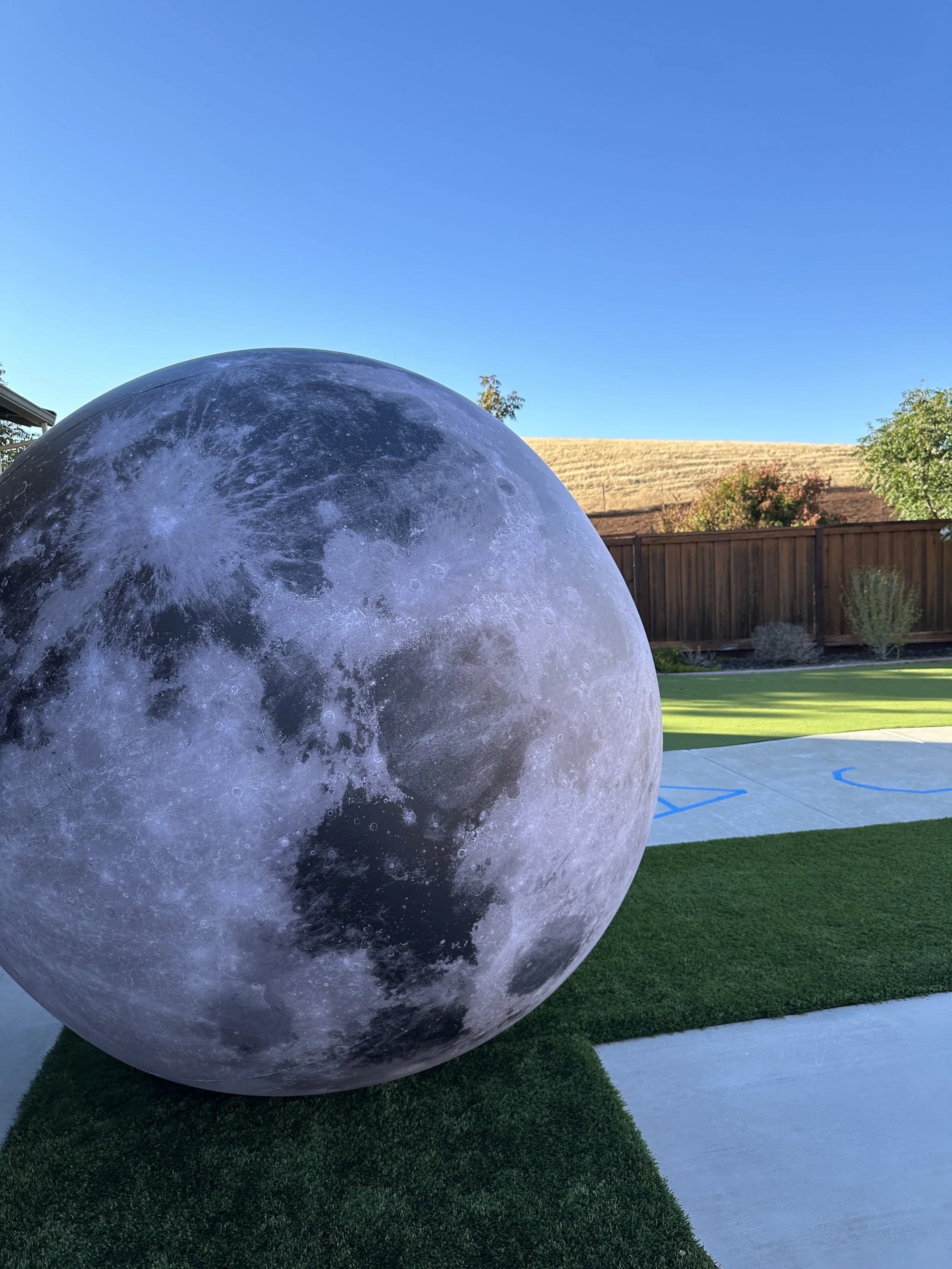
I found a massive inflatable Moon online and pressed ‘order’ on it without an ounce of hesitation. In the video, I wouldn’t exactly be standing ON the Moon, but alongside it, which was both the necessary practical solution for my independent low-budget artist lane, but also added a whimsical, odd quality to the visual that I must say I enjoyed thoroughly.
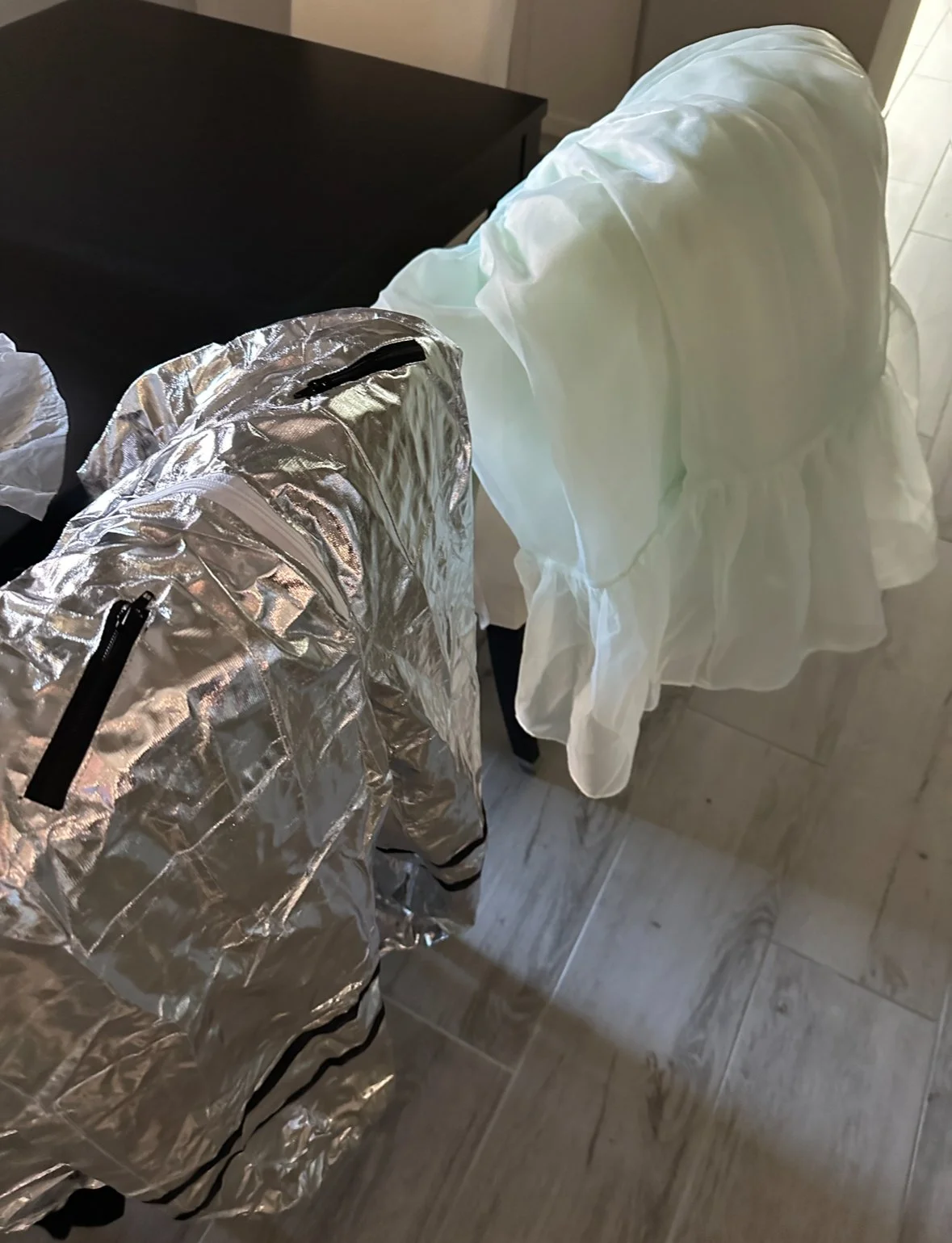
I also committed to the bit fully, and found an astronaut suit (read: costume). It was pure serendipity that this was all taking place in October, a few weeks before Halloween, when such space attires were circulating the economy in abundance.
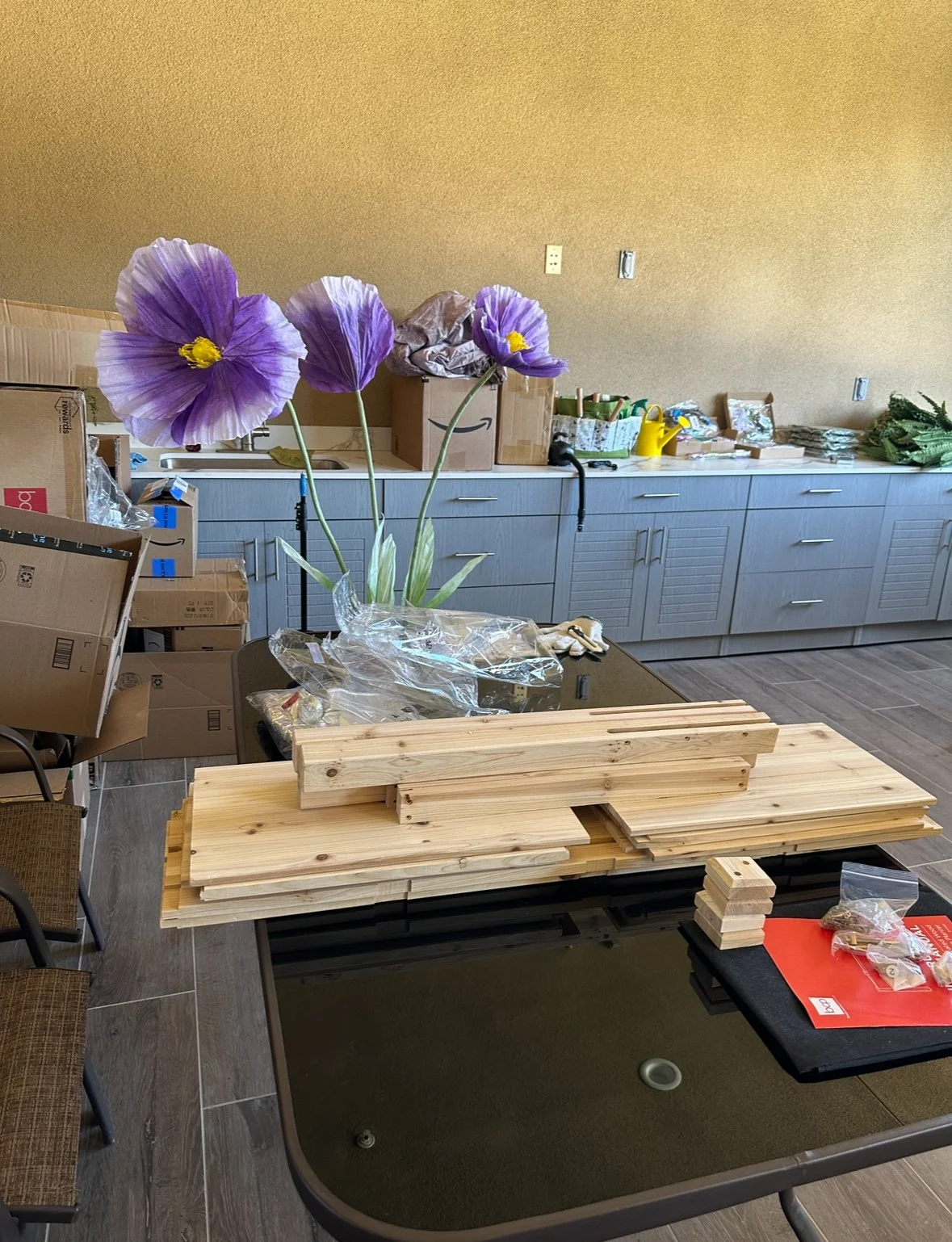
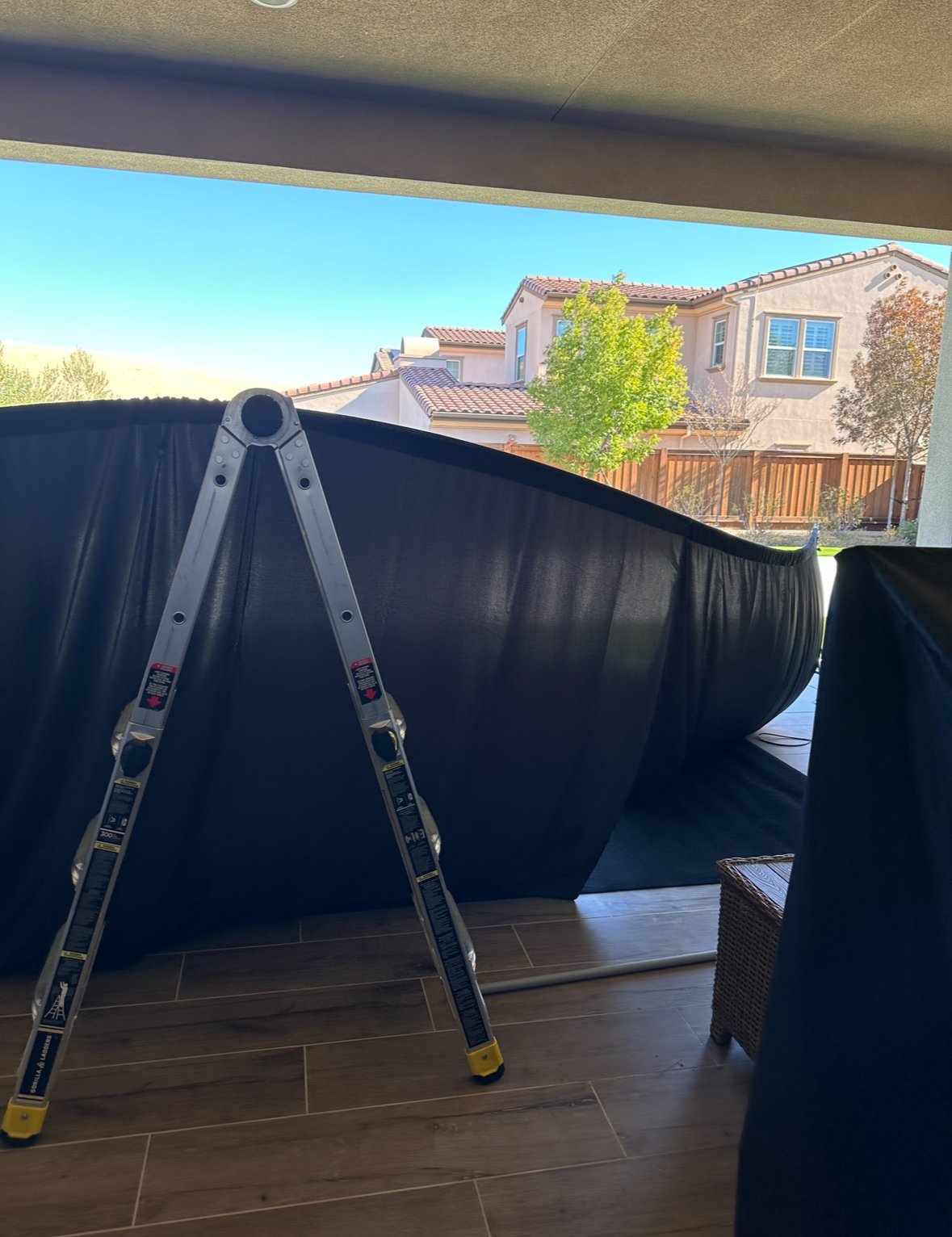
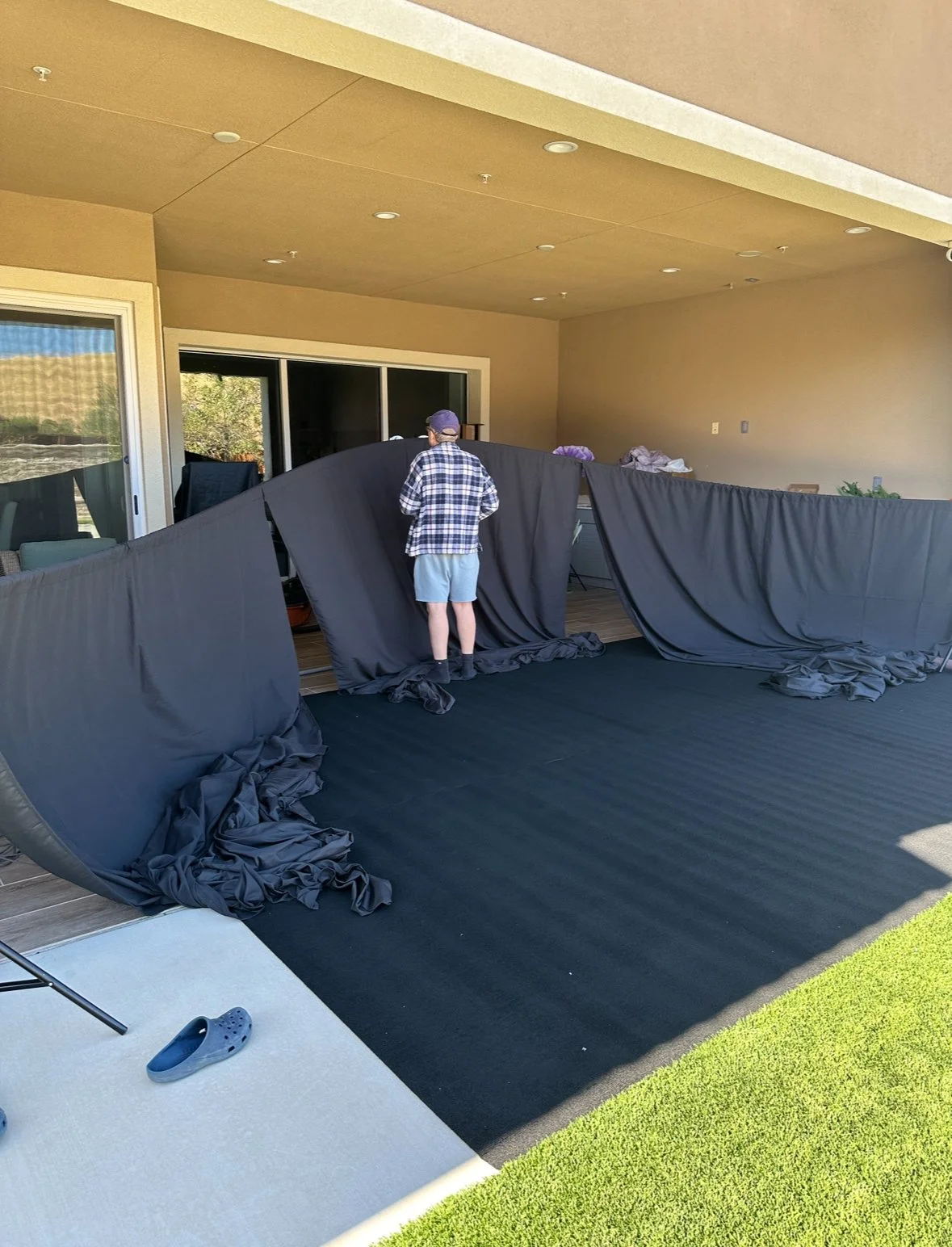
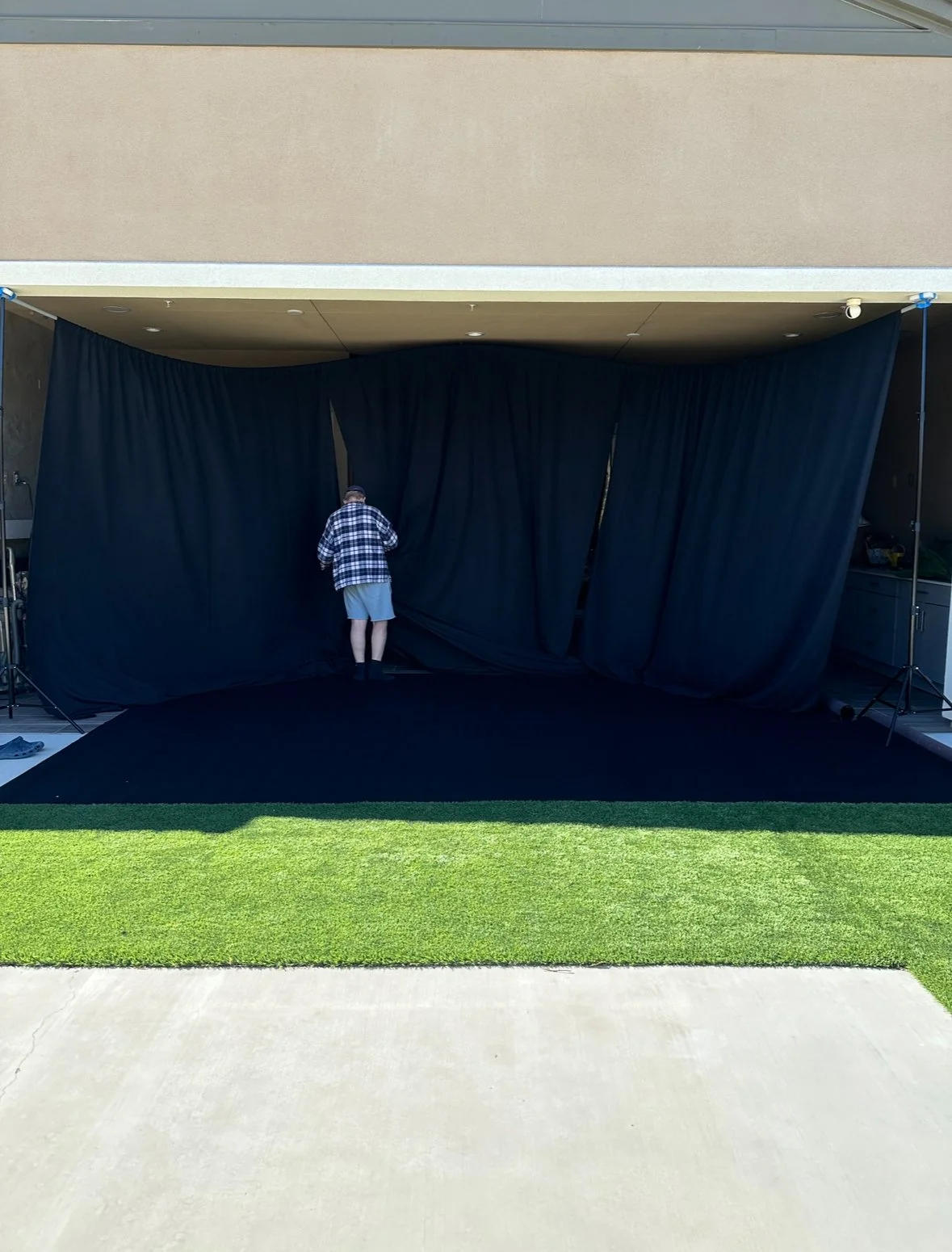
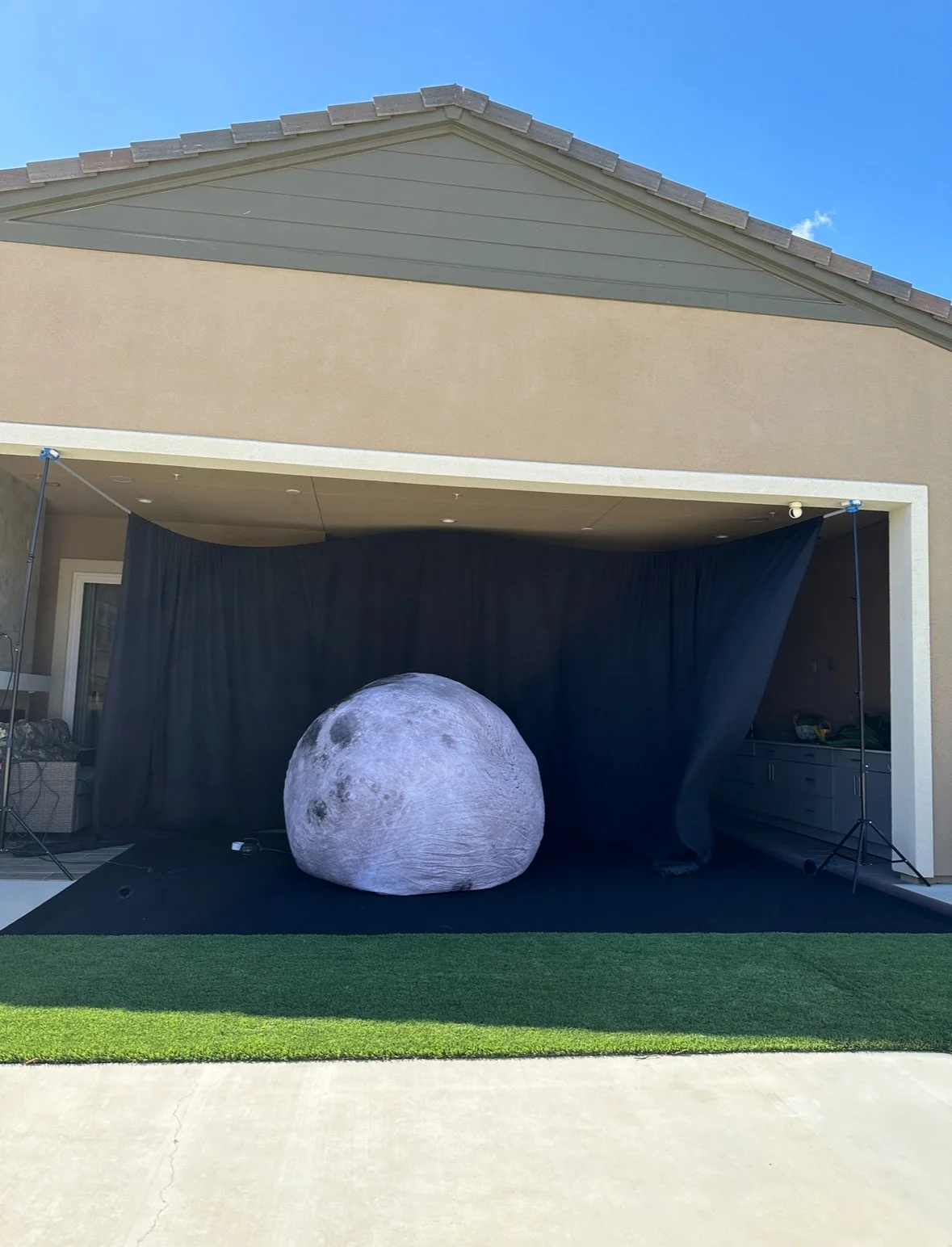
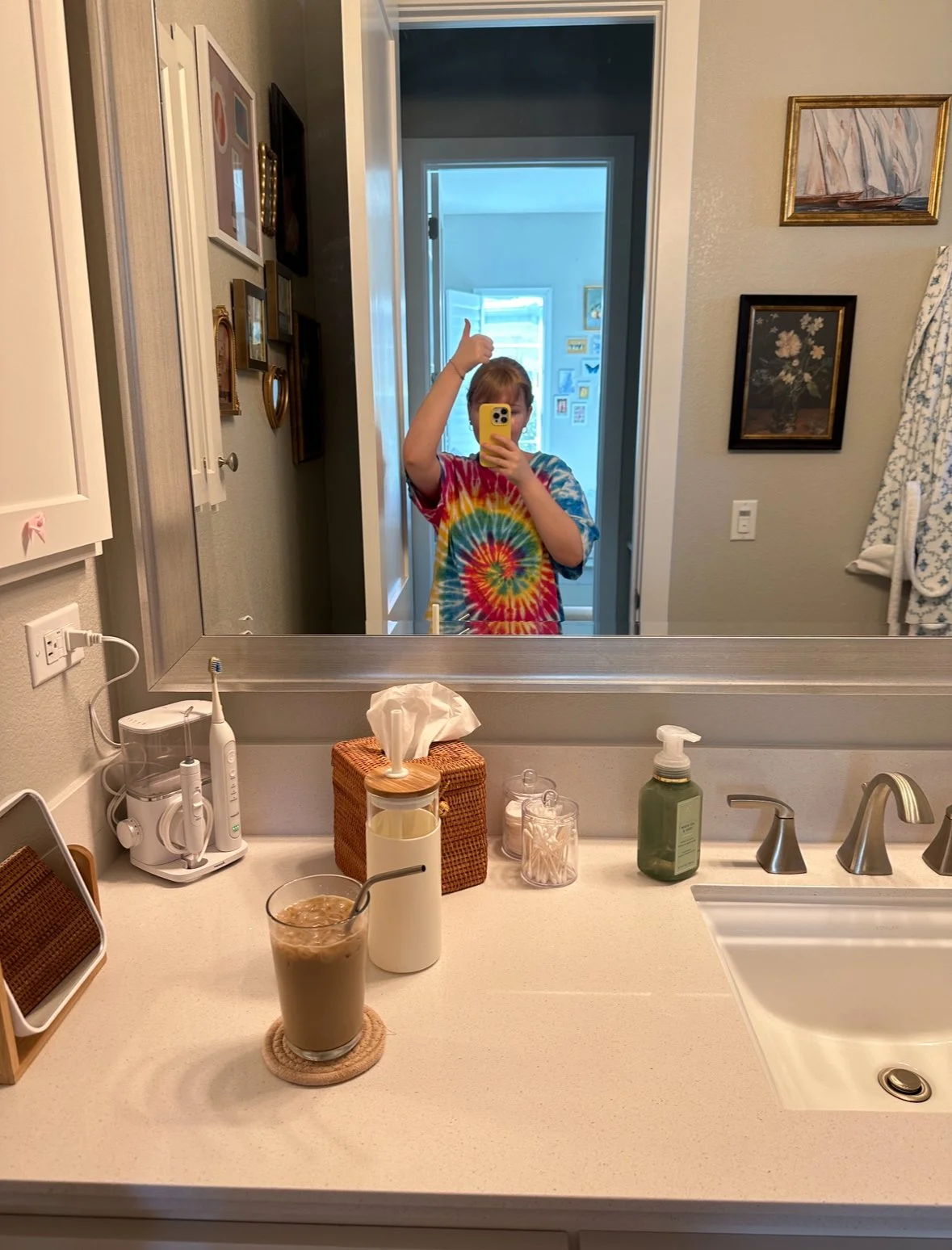
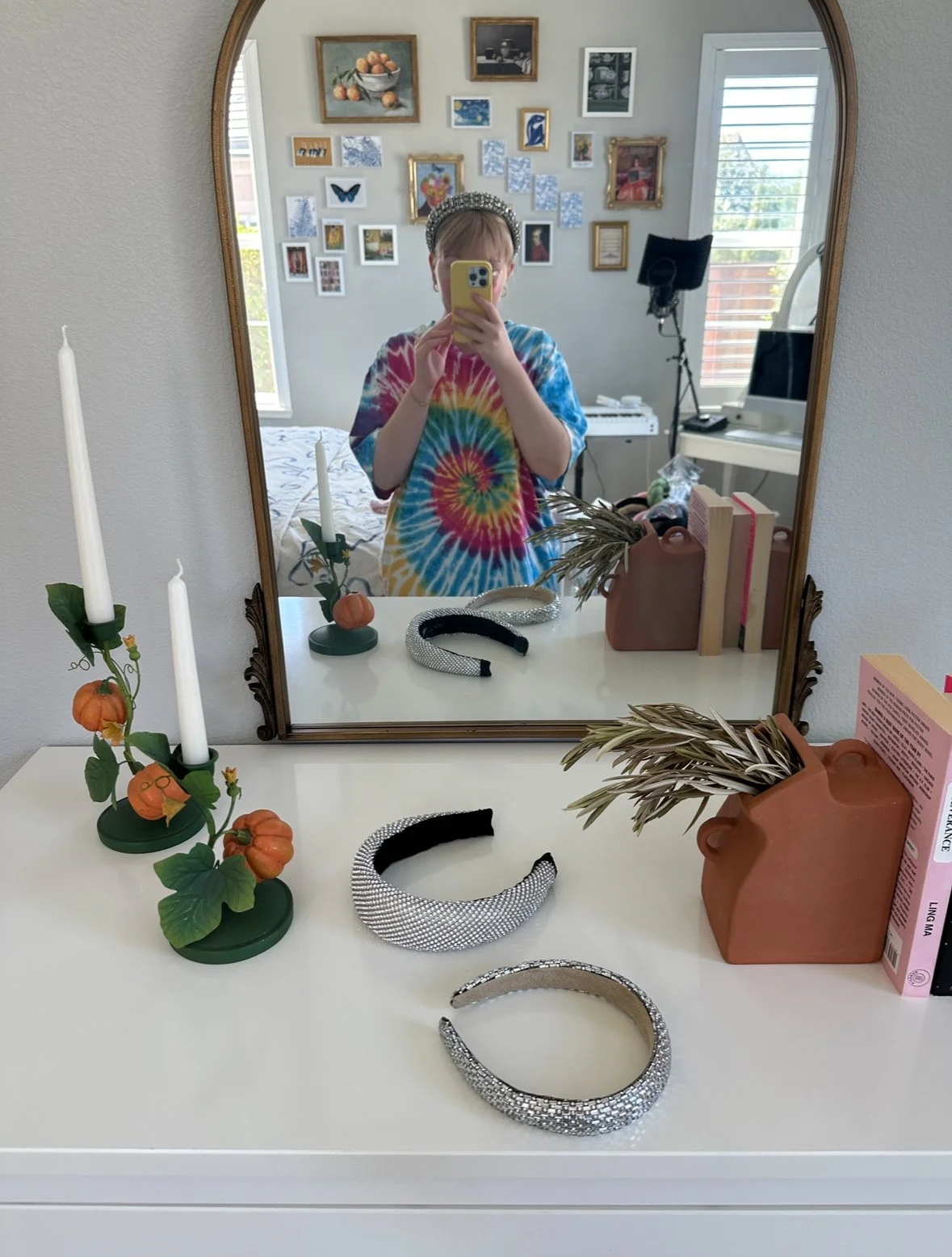
As is canonical by now, the video was filmed in my backyard, with the watchful eyes and helpful hands of my parents at my disposal. I really have to note here that none of this would have been possible without them - all I did was show up and go through a few takes of lip syncing (!!!). To continue with the orbiting theme of the song’s production, I had the idea of filming the video in circles / orbits. With each new shot / orbit, a new phase of the girl’s life on the Moon would be revealed. The end result really came together, but it also meant my mom had to run around in circles (literally) for the better part of that day - remember when I said none of this would be possible without my parents??? Yeah, that wasn’t hyperbole.
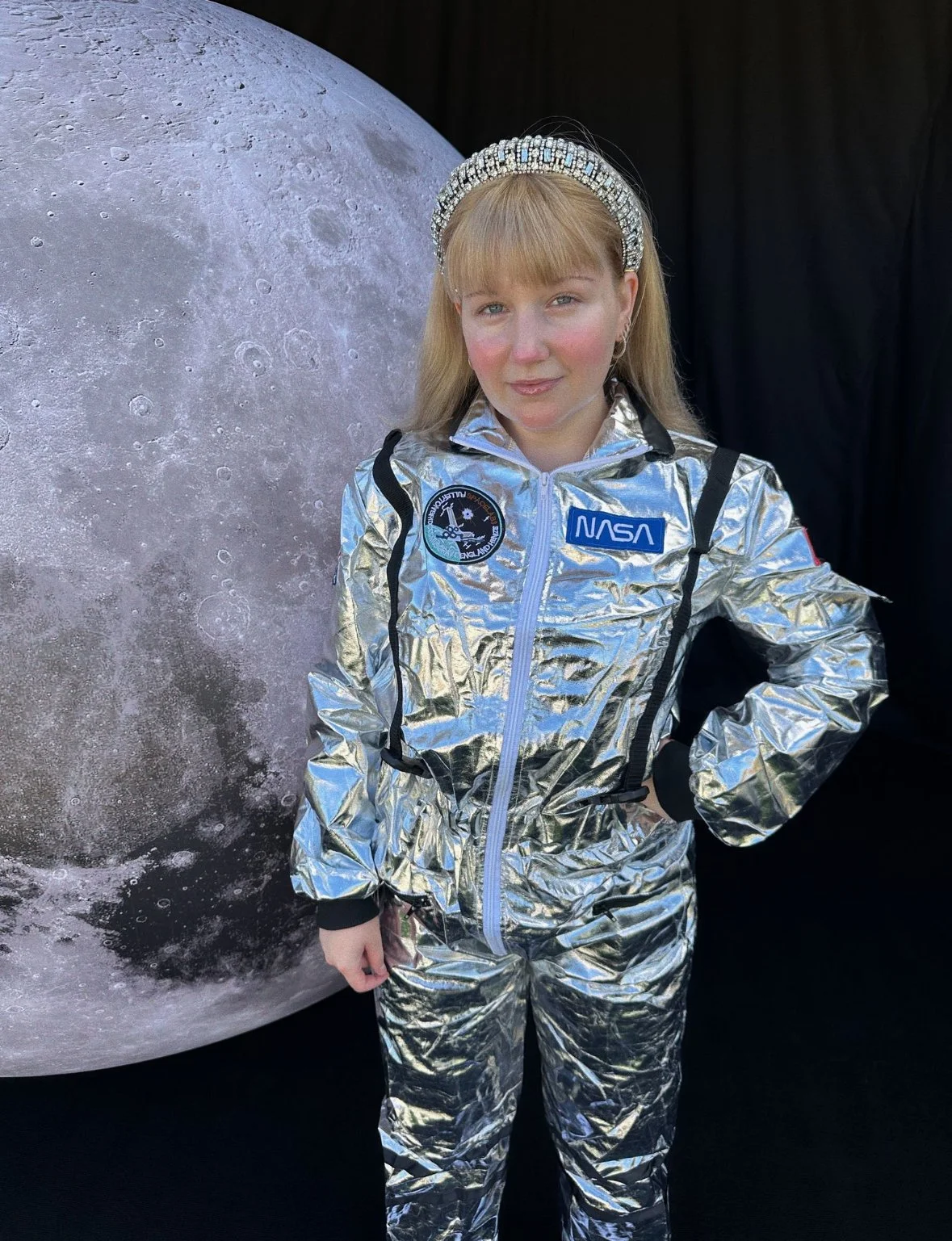
OUTFIT 1 - the astronaut
I liked starting the video with this outfit because it suggests an aversion, even fear, of the vacuum of space and the lunar surface. The character is fully dressed in protective gear, without any intention of inhabiting such a desolate place. Then, as the song goes on and each new orbit unfolds in the video, the girl slowly starts to take this suit off. As she’s building and assembling her garden, she is embracing her environment more, turning it into a home.
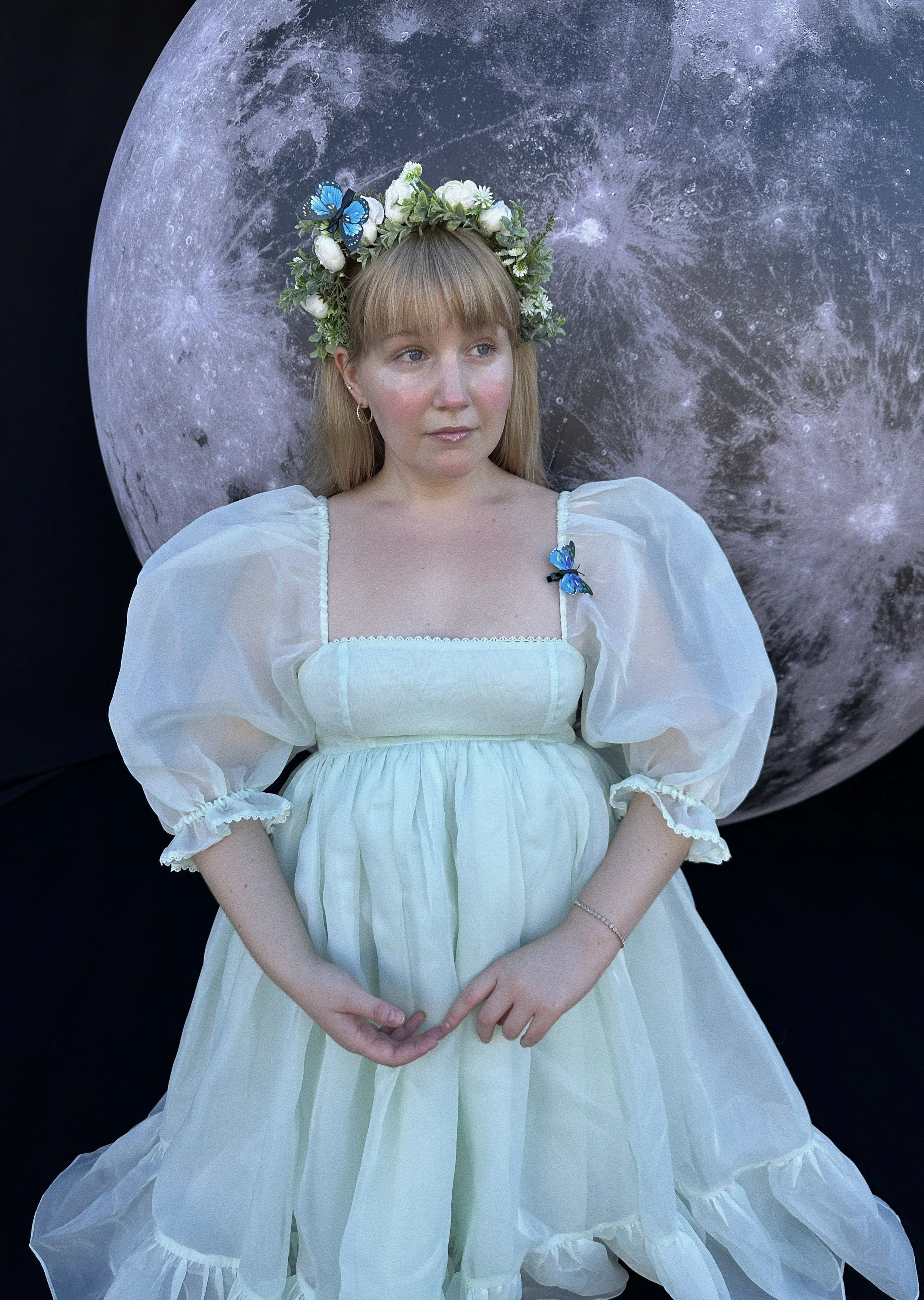
OUTFIT 2 - the gardener
Once the garden bed is completed and flowers start to grow, the girl also changes into a dress. The Moon is no longer hostile and daunting, but welcoming in its nascent bloom. Just as the girl embraces solitude and begins to see the beauty in it, so does her outfit reflect that newfound magic.
This was a track I had never planned on making. If it wasn’t for that book title I saw, it would have never even crossed my mind to combine my adoration and fascination of space with something so psychologically intricate, much less to talk about something so personal in a song that reverberated outside of my four bedroom walls. In that way, How To Grow Lilies On The Moon is the ultimate proof-of-concept for the At The Bookstore project - a song sparked by a book that started with a heaping of curiosity and ended with an exploration of self. I had SO much fun making this; I absolutely adored learning new production techniques and astrophysics facts to include in this song. I hope it gives you spark to search for the environment you thrive in, the courage to pursue it, and the comfort of knowing you’re staying true to yourself. Whether in a crowd and dancing under bright lights, or in a cottage reading by candlelight, there is nothing more noble and admirable than spending your life on your own terms. To summarize: whatever floats your boat bestie!! <3